Teaching your dog basic commands is one of the most important steps toward building a happy, safe, and healthy relationship. Whether you have a playful puppy, an energetic adult dog, or an older companion, learning simple commands can make everyday life easier. From walking politely on a leash to coming when called, these skills help dogs understand what you expect from them and respond more confidently in different situations.
However, dog training is about more than teaching your pet to follow instructions. It also helps build communication, improve impulse control, and encourage better behavior at home and in public. With patience, consistency, and the right approach, even dogs that struggle to focus can gradually develop useful obedience skills.
At Dancing Creek Farm, dog training focuses on communication, structure, confidence, and practical skills that help dogs succeed in everyday environments. Whether your dog needs help with basic manners or more structured obedience work, starting with the fundamentals can make a meaningful difference.
In this guide, we will explore seven essential dog commands every dog should know, how to teach them, common training mistakes to avoid, and when professional support may help.
Why Are Basic Dog Commands Important?
Basic commands give dogs clear guidance about how to behave in different situations. They are useful during walks, mealtimes, visits from guests, car rides, and interactions with unfamiliar environments.
Here are some important benefits of teaching your dog obedience commands:
- Improved safety: Commands such as “come” and “stay” can help you manage your dog around potential hazards.
- Better communication: Your dog learns to associate specific words and cues with expected behaviors.
- Stronger relationships: Consistent, fair training helps build trust between dogs and their owners.
- Improved manners: Commands can help reduce jumping, pulling, rushing through doors, and other unwanted behaviors.
- Greater confidence: Predictable guidance can help dogs feel more comfortable when learning new skills.
Remember that knowing a command does not mean a dog will respond perfectly in every situation. Dogs may perform well at home but struggle in a busy park or around other animals. Training needs to progress gradually so your dog can learn to respond in different environments.
1. Sit: The Foundation of Dog Obedience Training

“Sit” is one of the easiest and most useful commands to introduce. It encourages your dog to pause and focus instead of immediately acting on excitement.
You can use this command before putting on a leash, serving meals, greeting visitors, or opening a door.
How to teach your dog to sit
- Stand in front of your dog in a quiet, familiar area.
- Hold a small treat near your dog’s nose.
- Slowly move the treat upward and slightly toward the back of the dog’s head.
- As your dog naturally lowers its hindquarters, say “sit.”
- Reward the behavior immediately with praise or a treat.
- Repeat several times in short sessions.
If your dog jumps toward the treat, move your hand more slowly and keep the reward close to its nose.
Common mistake to avoid
Do not repeatedly say “sit, sit, sit” when your dog does not respond. Give the cue once, allow your dog a moment to process it, and help it succeed with a clear hand signal or a simpler setup.
With regular practice, your dog can begin sitting before meals, during greetings, and whenever you need a brief pause.
2. Stay: Teaching Patience and Self-Control

The “stay” command teaches your dog to remain in a particular position until you give a release cue. It can be useful when answering the door, preparing food, or organizing your dog’s leash before a walk.
For many dogs, staying still is harder than sitting because it requires patience and impulse control.
How to teach your dog to stay
- Ask your dog to sit or lie down.
- Say “stay” once and briefly pause.
- Reward your dog if it remains in position.
- Take one small step away, then return and reward it.
- Gradually increase the duration and distance as your dog becomes more reliable.
- Introduce a consistent release word, such as “free,” to signal that the exercise has ended.
Begin with just one or two seconds. A short, successful stay is more valuable than asking for a long stay that your dog cannot yet manage.
When should you practice stay?
Practice during calm moments at home before using the command around distractions. Once your dog understands the exercise, gradually introduce new locations and mild distractions.
Never rely on “stay” alone to protect your dog near traffic or other serious hazards. Use a secure leash and appropriate physical barriers whenever necessary.
3. Come: An Essential Recall Command

“Come” is one of the most important commands for dog safety. It teaches your dog to return to you when called, even when something interesting catches its attention.
Reliable recall can be especially helpful when a dog becomes distracted by wildlife, unfamiliar people, other dogs, or exciting outdoor activities.
However, recall takes time to develop. Dogs naturally want to investigate new smells and surroundings, so returning to their owners must become a rewarding habit.
How to teach your dog to come
- Start indoors or in a securely fenced area with minimal distractions.
- Say your dog’s name followed by “come” in a cheerful, clear voice.
- Take a few steps backward to encourage your dog to approach.
- When your dog reaches you, reward it immediately with praise, a treat, or a favorite toy.
- Repeat the exercise from gradually greater distances.
- Practice with a long training line in a safe outdoor area before introducing more distractions.
Always make returning to you a positive experience. Avoid calling your dog to you only when something enjoyable is about to end, such as leaving the park every time.
Why recall matters
A dog that responds to recall is easier to manage during outdoor activities and everyday routines. Nevertheless, no command is completely reliable in every situation. Keep your dog leashed in public areas where required and around roads, livestock, wildlife, or other hazards.
4. Down: Encouraging Calm Behavior
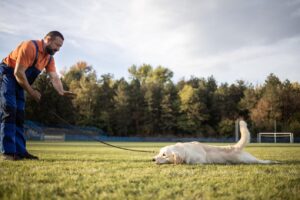
The “down” command teaches your dog to lie down when asked. It can help during quiet time at home, visits with friends, and situations where you want your dog to settle rather than move around constantly.
Some dogs find this command easy, while others may feel uncomfortable lying down on unfamiliar surfaces. Be patient and allow your dog to learn at a comfortable pace.
How to teach your dog down
- Ask your dog to sit if it already knows that command.
- Hold a treat near its nose.
- Slowly guide the treat toward the floor between its front paws.
- Move the treat slightly forward so your dog follows it into a lying position.
- As the dog lies down, say “down” and reward it.
- Repeat in short sessions until your dog begins responding to the verbal cue.
If your dog stands up instead of lying down, make the movement slower or try again from a comfortable starting position.
How this command helps at home
A dog that understands “down” can learn to settle while the family eats dinner, watches television, or welcomes visitors. Over time, you can pair the command with a mat or designated resting area.
Remember that a dog lying down on command is not necessarily relaxed. Watch its body language and avoid forcing a fearful or uncomfortable dog into a position.
5. Leave It: Preventing Unwanted Choices

Dogs explore the world with their noses and mouths. Unfortunately, that curiosity can lead them toward dropped food, household objects, rubbish, or other potentially dangerous items.
“Leave it” teaches your dog to disengage from something and pay attention to you instead.
How to teach leave it
- Place a low-value treat in your closed hand.
- Allow your dog to sniff your hand without opening it.
- Wait until your dog briefly stops investigating or looks away.
- Mark the desired behavior with a word such as “yes,” then reward with a different treat from your other hand.
- Add the verbal cue “leave it” once your dog begins understanding the exercise.
- Gradually practice with different objects and situations while maintaining appropriate supervision.
Do not begin by placing dangerous objects in front of your dog or allowing it to grab something unsafe for practice.
Why leave it is useful
This command helps develop impulse control and gives your dog an alternative to immediately investigating every object.
If your dog already has something dangerous in its mouth, “leave it” may not be enough. A separately trained “drop it” cue can help teach your dog to release an object safely. If an item may be toxic or harmful, contact a veterinarian promptly rather than relying on training alone.
6. Heel: Building Better Leash Manners
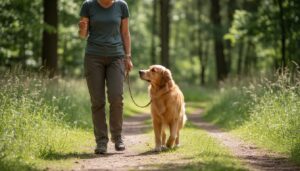
Walking a dog that constantly pulls on the leash can turn a relaxing outing into a frustrating experience. The “heel” command teaches a dog to walk close to its handler with attention and control.
A formal heel usually means the dog stays beside the handler in a defined position. It is different from a relaxed walk on a loose leash, where the dog has more freedom to sniff and explore without pulling.
Both skills are valuable, and the best choice depends on your dog’s needs and the situation.
How to teach your dog to heel
- Begin in a quiet area with your dog wearing a properly fitted harness or collar suitable for its training needs.
- Choose the side on which you want your dog to walk.
- Hold a reward near your leg to encourage the correct position.
- Say “heel” and take a few steps.
- Reward your dog when it stays near you without pulling.
- Practice short turns and changes of direction.
- Gradually introduce mild distractions as your dog improves.
Keep early sessions brief. If your dog becomes overly excited, increase your distance from the distraction or return to a quieter area.
What if your dog keeps pulling?
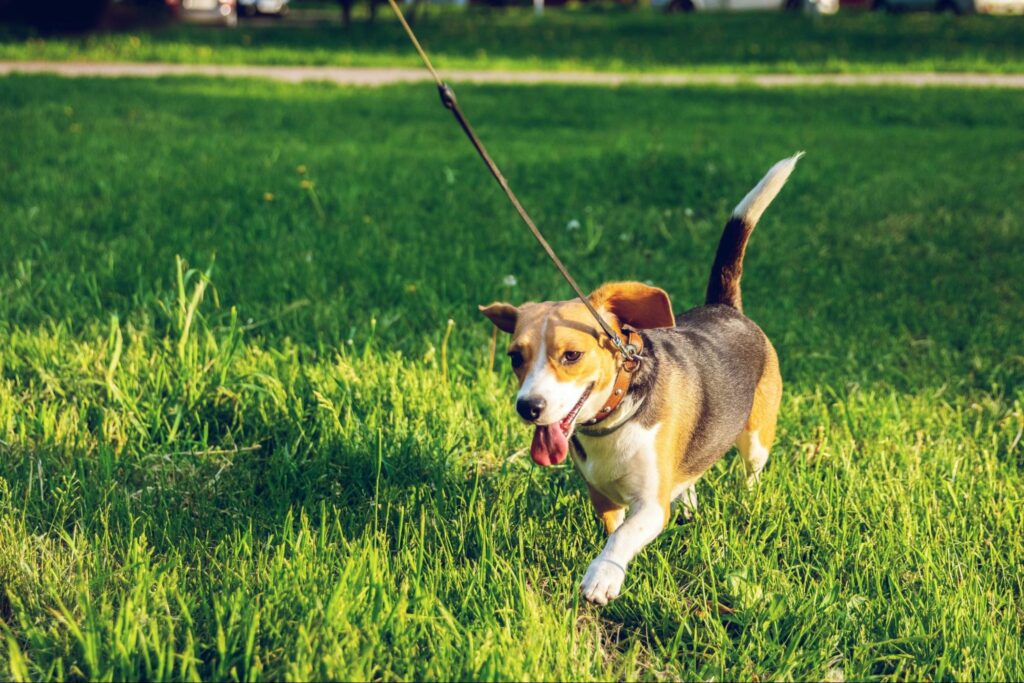
Avoid turning every walk into a battle. Pulling can be influenced by excitement, fear, frustration, learned habits, or the environment.
Reward your dog for walking beside you, maintain a manageable pace, and practice in places where your dog can focus. If pulling is severe or accompanied by lunging and reactivity, professional guidance may help identify the underlying issue.
Dancing Creek Farm offers professional dog training that includes loose-leash skills and obedience foundations. Learn more about our dog training services in Virginia.
7. Place: Teaching Your Dog Where to Settle

The “place” command teaches your dog to go to a designated location, such as a dog bed or mat, and remain there until released.
It can be particularly useful for dogs that jump on guests, follow family members everywhere, or struggle to settle when something exciting happens.
Unlike “sit” or “down,” place connects the behavior to a specific location.
How to teach place
- Choose a comfortable mat or dog bed in a quiet area.
- Encourage your dog to step onto the mat using a treat or a familiar hand signal.
- As your dog reaches the mat, say “place” and reward it.
- Encourage your dog to sit or lie down on the mat if appropriate.
- Reward brief periods of remaining there.
- Gradually increase the duration before giving your release cue.
Practice when your dog is calm before using place during busy moments, such as family meals or visitor arrivals.
How place improves household manners
A dog that understands place can have a predictable spot to settle while the family cooks, works, or receives guests. It can also help establish boundaries without constantly telling the dog to move away.
Start with short periods and build gradually. Do not use the mat as punishment or expect a dog to remain there for longer than it can comfortably manage.
How to Make Dog Training More Effective
Learning seven commands is a useful starting point, but the way you practice matters just as much as the commands themselves.
Keep training sessions short
Several short sessions throughout the day are often easier for dogs than one long lesson. Begin with a few minutes and stop before your dog becomes frustrated or loses interest.
Use rewards that motivate your dog
Food rewards, praise, toys, and play can all help reinforce desirable behavior. Choose rewards that suit your dog’s preferences and health needs.
Reward the behavior you want as soon as possible so your dog can understand what earned the reward.
Be consistent with commands
Choose clear verbal cues and make sure everyone in the household uses them consistently. If one person says “down” to mean lie down while another uses it to mean get off the sofa, the dog may become confused.
Practice in different environments
A dog may understand “come” in the kitchen but ignore it in the yard. This does not always mean the dog has forgotten the command. The outdoor environment may simply be more distracting.
Practice in progressively more challenging settings, adjusting the distance and distractions to your dog’s current ability.
Avoid punishment and unrealistic expectations
Dogs learn at different rates. Fear, stress, fatigue, pain, and unfamiliar surroundings can all affect performance.
Use clear instructions, appropriate rewards, and calm guidance. If your dog’s behavior changes suddenly or it appears reluctant to perform a familiar movement, consult a veterinarian to rule out pain or illness.
When Should You Consider Professional Dog Training?
Home practice can establish a strong foundation, but some dogs need additional guidance. Professional training may be helpful when your dog:
- Pulls strongly on the leash or lunges at distractions.
- Ignores recall commands outdoors.
- Becomes overly excited around visitors.
- Struggles with impulse control and household boundaries.
- Appears fearful or overwhelmed in unfamiliar environments.
- Understands commands at home but cannot perform them consistently elsewhere.
A qualified trainer can assess your dog’s behavior, identify practical training goals, and help you develop a consistent plan. For fear, aggression, or severe anxiety, look for an appropriately qualified professional who can work with your veterinarian when needed.
Dancing Creek Farm offers private training and board-and-train options for dogs with different training needs. Programs include basic obedience, leash manners, household behavior, and more advanced work depending on the dog’s individual circumstances.
Explore our professional dog training programs to learn more about the available options.
A Practical Example From Dancing Creek Farm
Consider a common training scenario: a family has an energetic dog that sits when asked at home but pulls hard during walks, rushes toward the door when visitors arrive, and ignores recall when distracted by outdoor smells.
Although the dog knows a few commands, it struggles to use them consistently in everyday situations.
A practical training plan could begin by reinforcing sit and stay in quiet surroundings, introducing place for calmer greetings, and rewarding the dog for walking beside its handler on a loose leash. Recall practice could start in a secure area before progressing to more distracting environments.
At Dancing Creek Farm, the training approach emphasizes clear communication, structure, confidence, and practice that reflects real-life situations. The family would also need to learn how to reinforce the same expectations at home.
This example illustrates a training scenario rather than a claim about a specific client’s results. It shows why teaching commands individually is only the beginning. Dogs also need opportunities to practice those skills in situations they encounter every day.
Conclusion
The seven basic dog commands every dog should know are sit, stay, come, down, leave it, heel, and place. Together, they provide a useful foundation for safety, impulse control, leash manners, and calmer behavior at home.
Start with one command at a time, keep practice sessions short, and reward progress consistently. As your dog improves, gradually introduce new environments and distractions without expecting immediate perfection.
Most importantly, remember that effective training is an ongoing partnership between you and your dog. Patience, clear communication, and realistic expectations can help your dog become a more confident and manageable companion.
If you need help building reliable obedience skills, Dancing Creek Farm provides professional dog training services in Virginia designed around practical behavior and individual training needs.
FAQs
1. What are the seven basic dog commands every dog should know?
The seven useful commands are sit, stay, come, down, leave it, heel, and place. They help dogs learn basic manners, improve communication, and respond more appropriately in everyday situations.
2. At what age should I start teaching my dog basic commands?
You can begin teaching simple skills as soon as you bring your puppy home, often around eight weeks of age. Use short, positive sessions suited to your puppy’s attention span. Adult and senior dogs can also learn new commands.
3. How long does it take a dog to learn basic commands?
Some dogs begin understanding a simple command within a few sessions, while others need weeks or longer to respond consistently. Progress depends on the dog’s age, experience, motivation, environment, and the regularity of practice.
4. How do I teach my dog to listen when distracted?
Start practicing in a quiet environment where your dog can focus. Reward successful responses, then gradually introduce mild distractions and new locations. If your dog repeatedly struggles, make the exercise easier before increasing the difficulty.
5. Can professional dog training help a dog that pulls on the leash?
Yes. Professional training can help identify why a dog pulls and teach more appropriate walking behavior. A trainer can develop a plan around your dog’s excitement, fears, habits, and response to distractions.