What You Need To Know
- Start with the AAFCO statement. It tells you if the food is “complete and balanced” and for which life stage.
- Decode the name. “Beef Dog Food,” “Beef Dinner,” and “with Beef” require very different amounts of beef.
- Compare on a dry matter basis. Wet and dry foods can’t be compared straight off the label.
- Use the ingredient list for red flags, not as a quality score.
- New labels are coming. A “Pet Nutrition Facts” box must be on every bag by 2030.
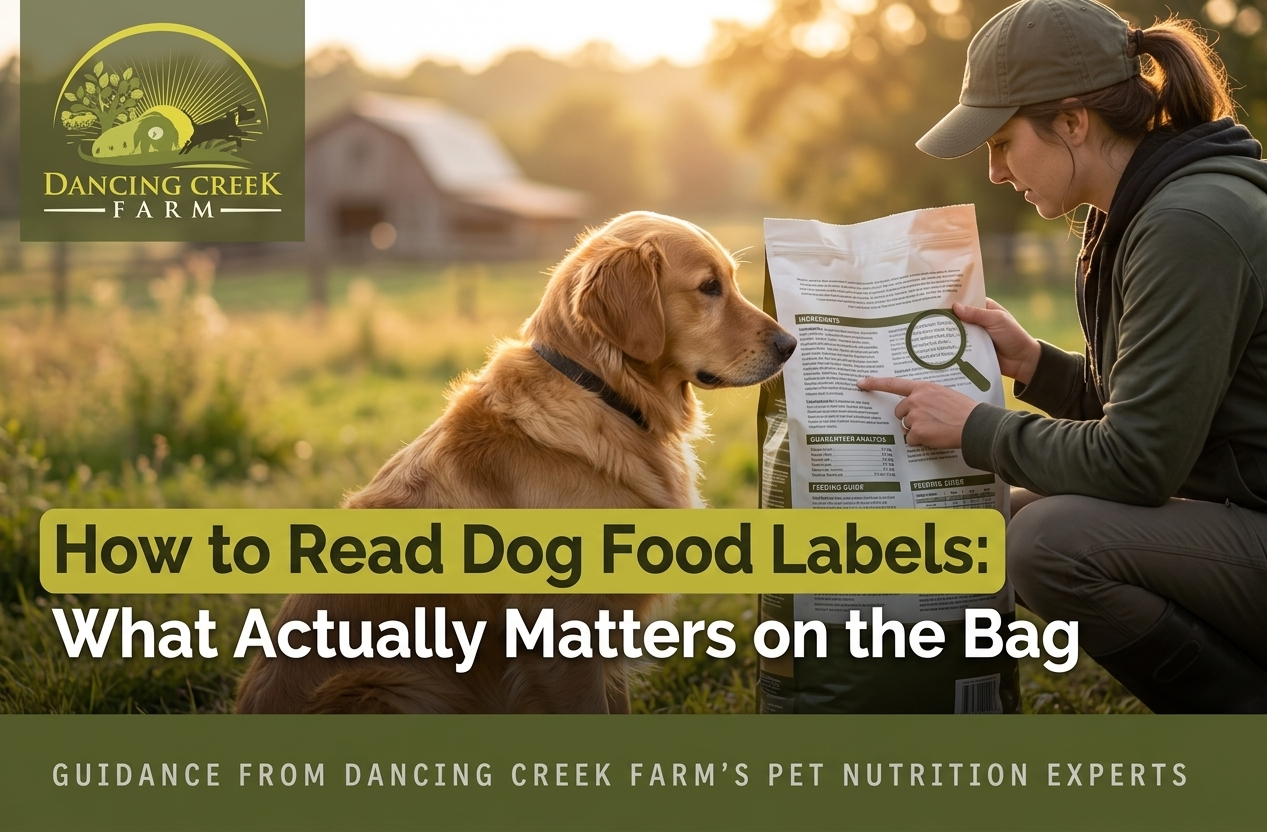
Learning how to read dog food labels takes about ten minutes, and it changes how you shop for good. A label is a legal document with a marketing department stapled to the front.
Short answer: Read the AAFCO nutritional adequacy statement first, then the product name, the guaranteed analysis, the calories, and finally the ingredient list. The statement tells you if the food is a complete diet. The rest tells you how much of what.
We’ve cared for dogs at Dancing Creek Farm in Cascade, Virginia since 2005, and owners hand us bags of every brand imaginable. Our honest opinion: most people read the label backwards. They start with the ingredients. We’d start with the small print on the side.

What information is on a dog food label?
Every dog food label sold in the US carries the same required parts. The Association of American Feed Control Officials (AAFCO), which writes the model rules most states adopt, lists them on its Reading Labels page, last updated June 2024.
| Label part | Where it is | What it tells you |
|---|---|---|
| Product name | Front | How much of a named ingredient is inside |
| Species | Front | Who the food is for |
| Guaranteed analysis | Back or side | Minimum protein and fat, maximum fiber and moisture |
| Ingredient list | Back or side | Ingredients in order of weight |
| Nutritional adequacy statement | Small print | Complete and balanced or not, and for which life stage |
| Calorie content | Back or side | Calories per kilogram and per cup or can |
| Feeding directions | Back | A starting portion, not a rule |
| Manufacturer | Back | Who stands behind the food |
Think of it like a car’s window sticker. The front shows the paint job. The fuel economy and safety ratings live in the small box on the side.
Why should you read the AAFCO statement first?
The nutritional adequacy statement is the most useful line on the bag. It tells you whether the food can be your dog’s whole diet or is only a treat or topper.
The FDA explains that a food earns the “complete and balanced” claim in one of two ways: it meets an AAFCO Dog Food Nutrient Profile, or it passes an AAFCO feeding trial (FDA, complete and balanced pet food).
The wording tells you which route the food took:
- Formulation: “…is formulated to meet the nutritional levels established by the AAFCO Dog Food Nutrient Profiles for…”
- Feeding trial: “Animal feeding tests using AAFCO procedures substantiate that…”
A feeding trial means real dogs ate the food and stayed healthy. Formulation means the recipe hit the numbers on paper. Both are legitimate.
Then check the life stage. AAFCO recognizes four: gestation/lactation, growth, maintenance, and all life stages. “Senior” isn’t one of them.
One caveat: AAFCO itself does not regulate, test, approve or certify pet food. The FDA and state agencies enforce the rules.
What do product names like “dinner” and “with” really mean?
The product name follows strict percentage rules, and one small word changes everything. These come straight from AAFCO’s label guidance:
| Name on the bag | Rule | Named ingredient required |
|---|---|---|
| “Beef Dog Food” | 95% rule | At least 95%, not counting added water (70% with water) |
| “Beef Dinner,” “Entrée,” “Platter” | 25% rule | At least 25%, not counting water (10% with water) |
| “Dog Food with Beef” | “With” rule | At least 3% |
| “Beef Flavor Dog Food” | Flavor rule | No minimum; just enough to detect |
Here’s a menu analogy. “Pepperoni pizza” is mostly about the pepperoni. “Pizza with pepperoni” might have four slices on it. “Pepperoni-flavored pizza” may have never met a pepperoni.
So under the 25% rule, a “Chicken Dinner” can hold far less chicken than “Chicken Dog Food” from the same brand. Turn the bag over before you trust the front.
How do you read the guaranteed analysis on dog food?
The guaranteed analysis on dog food lists four required numbers: minimum crude protein, minimum crude fat, maximum crude fiber, and maximum moisture. “Crude” describes the lab method, not ingredient quality.
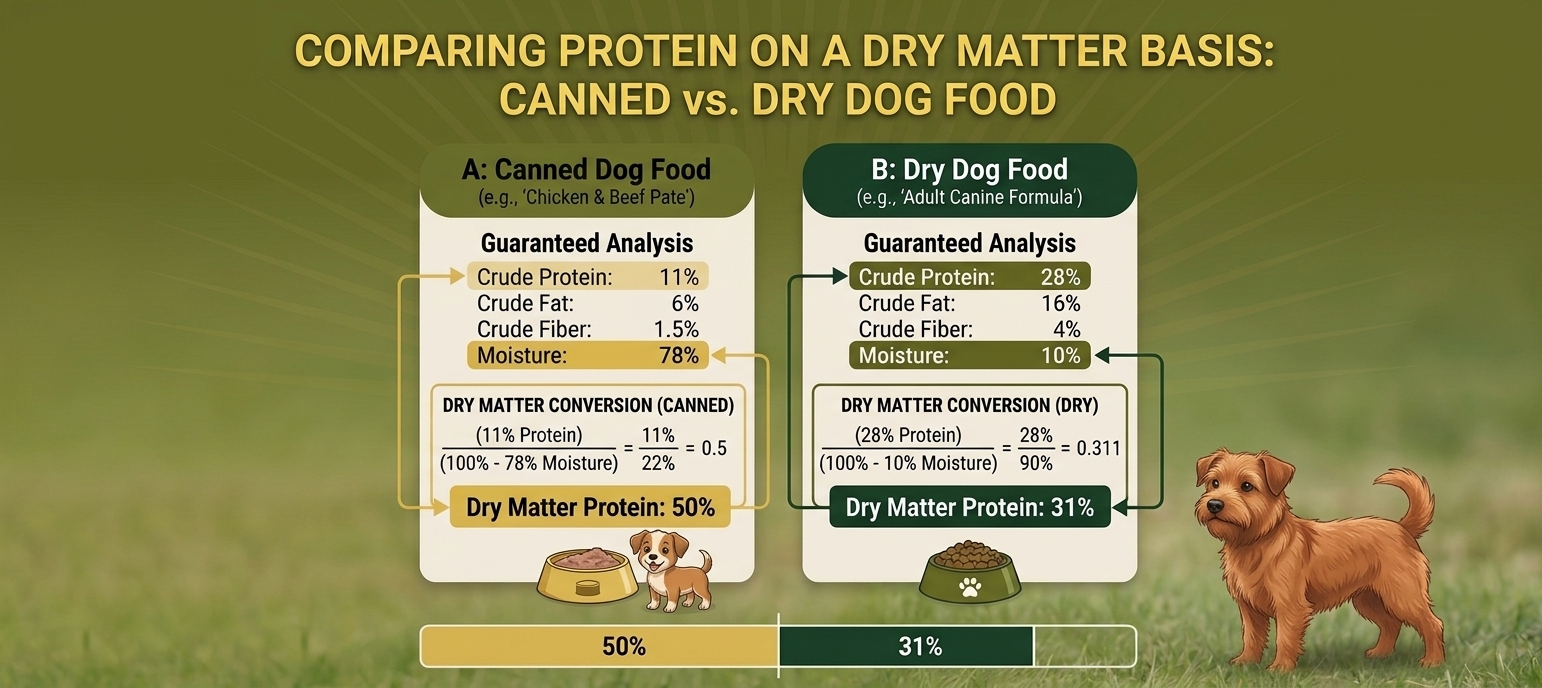
The trap is moisture. Comparing a can to a bag straight off the label is like weighing a wet sponge against a dry one. You have to wring out the water first.
That’s the dry matter basis, and the FDA recommends it for comparing foods:
- Subtract moisture from 100 to get dry matter.
- Divide the protein figure by the dry matter.
- Multiply by 100.
Say a can reads 8% protein and 78% moisture. Dry matter is 22%, so protein is about 36% on a dry basis. A kibble at 26% protein and 10% moisture works out to about 29%. The can carries more protein in dog food terms, even though its label number looks tiny.
Next, find the calorie content, listed per kilogram and per cup or can. AAFCO caps a “lite” dry food at 3,100 kcal per kilogram. Calories decide portion size far more than protein does.
How do you read the ingredient list?
Ingredients are listed from most to least by weight, measured before cooking. That makes fresh meat look bigger than it is, because raw meat is heavy with water.
A meal, like “chicken meal,” is the opposite. AAFCO notes that rendering removes most of the water and fat, leaving concentrated protein. So “chicken meal” in third place can supply more protein than “chicken” in first.
Tufts’ Petfoodology team, veterinary nutritionists at the Cummings School, say judging a food by its ingredient list usually isn’t a good way to choose. The list says nothing about quality or proportions.
We agree, with one exception: it’s great for spotting red flags.
- Window dressing: blueberries or kale listed after salt are tiny amounts. PetPlace notes fruits and vegetables after salt are typically under 1% of the diet.
- Split ingredients: “peas, pea protein, pea fiber” listed separately can each rank lower than one combined entry.
- Unnamed sources: we prefer “chicken fat” over a generic “animal fat,” so you know what your dog is eating.
What are healthy dog food ingredients?
Healthy dog food ingredients are the ones that, together, make the food complete and balanced for your dog. No single ingredient makes a food good. Still, the best dog food ingredients lists tend to share a few traits:
- A named animal protein or meal near the top, such as chicken, lamb, or salmon meal.
- Digestible carbohydrates like rice, oats, barley, or corn.
- A named fat source such as chicken fat or fish oil.
- Natural preservatives like mixed tocopherols (a form of vitamin E).
- Added vitamins and minerals. AAFCO notes that chemical-sounding names like DL-Methionine are usually just nutrients.
Are by-products in dog food bad?
By-products in dog food aren’t automatically bad. AAFCO defines a by-product as a secondary product made alongside the main one, and says by-products can safely provide nutrition.
In practice, that often means organs like liver and kidney. Plenty of people won’t eat liver. Most dogs think it’s the best part of the meal.
Are dog food fillers a problem?
You won’t find the word “filler” on any label. It’s what critics call grains and starches like corn, wheat, and rice.
These ingredients supply energy, fiber, and some protein. Tufts’ Petfoodology blog even defended corn in a 2023 post titled “Stalk About Nutritious: It’s Corn!” The real problem is a food built mostly on cheap starch, and the dry matter math will expose it.
Which dog food ingredients should you avoid?
There’s no official list of dog food ingredients to avoid, and much of what circulates online is fear rather than evidence. Here’s where we land:
| Ingredient | What it does | Our take |
|---|---|---|
| BHA, BHT, ethoxyquin | Synthetic preservatives for fats | Legal, but debated. We’d choose mixed tocopherols when you can. |
| Propylene glycol | Keeps semi-moist food soft | Banned in cat food under 21 CFR 589.1001; allowed for dogs. We’d skip it. |
| Artificial colors | Dyes that appeal to owners | Your dog doesn’t care what color kibble is. |
| Added sugar or syrup | Makes food tastier | Unneeded calories in a daily diet. |
BHA and propylene glycol are both legal in dog food, so this is caution, not alarm. Notice what’s missing: by-products, corn, and grains get blamed a lot online, but regulators’ documents don’t back that up.
Is grain free dog food healthier?
Grain free dog food isn’t healthier by default. It swaps grains for other starches, often peas, lentils, or potatoes.
The FDA investigated reports of a heart condition called dilated cardiomyopathy (DCM) in dogs, many eating grain-free diets high in peas or lentils.
In December 2022, the FDA ended routine public updates, saying the reports didn’t establish a causal link.
That isn’t a clean bill of health either, so talk to your vet before choosing grain-free. Front-of-bag words like “holistic” carry no legal meaning at all, which we cover in our guide to holistic dog nutrition.
How are dog food labels changing by 2030?
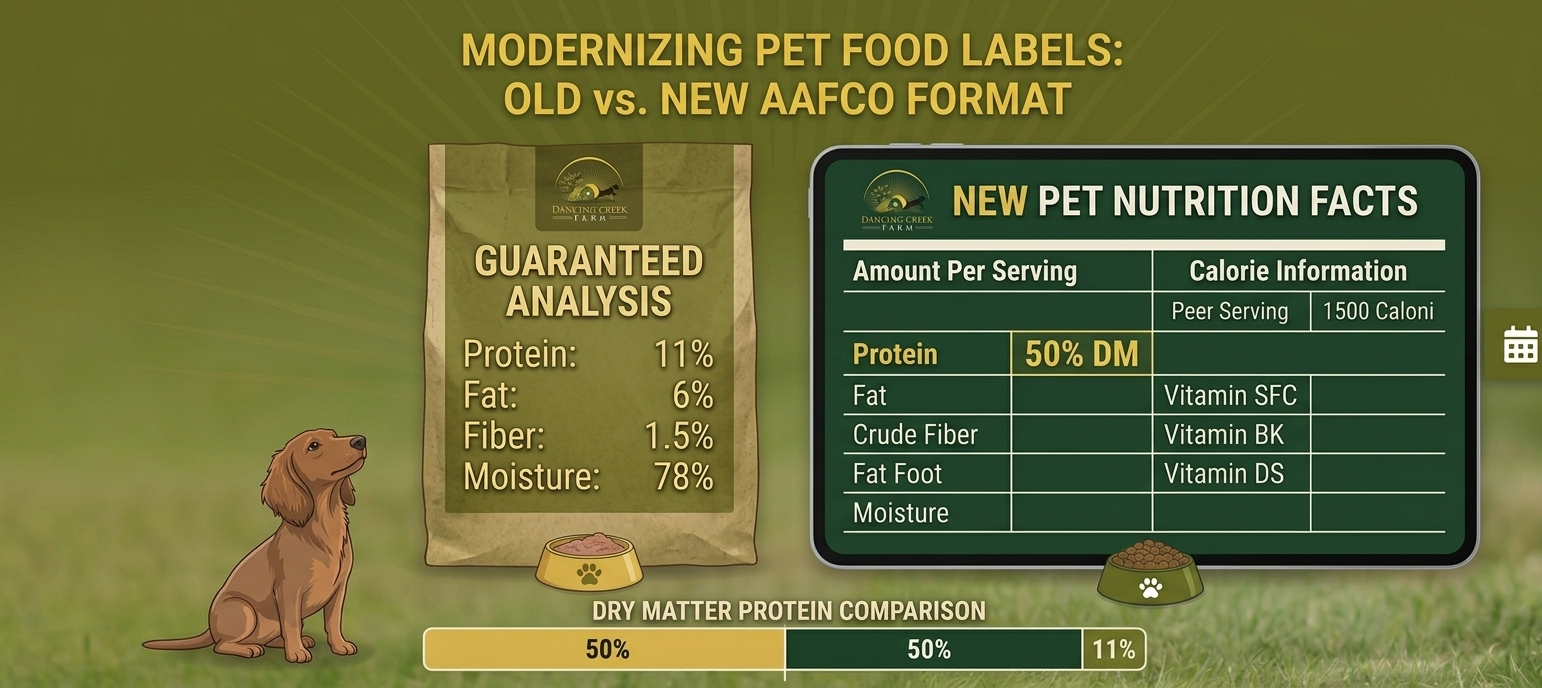
AAFCO’s Pet Food Label Modernization (PFLM) is the biggest change to pet food labels in about 40 years. Its model regulations were published in January 2024, starting a six-year transition that ends in 2030, per Petfood Industry as of July 2026.
Under Pet Food Label Modernization, you’ll start seeing:
- A Pet Nutrition Facts box: a black-and-white panel modeled on human food labels, replacing the old guaranteed analysis.
- New numbers: total carbohydrate and dietary fiber.
- A front-of-bag intended use statement: the AVMA reports it sits on the lower third of the front panel.
Expect both formats on shelves until 2030. Everything in this guide still applies; the information simply moves into one box.
Is your dog food healthy? A 6-step label check
Run through these steps with the bag in hand:
- Find the AAFCO statement and confirm “complete and balanced” for your dog’s life stage.
- Read the name and apply the 95%, 25%, “with,” or flavor rule.
- Convert to dry matter if you’re comparing wet and dry foods.
- Check calories per cup against the portion you actually pour.
- Scan the ingredient list for red flags: synthetic preservatives, dyes, window dressing.
- Read the manufacturer line. The World Small Animal Veterinary Association (WSAVA) suggests asking if a food is “made by” the company or “made for” it, and who formulates it.
Then look at your dog. Weight, coat, energy, and stool over several weeks are the final report card. If a diet change upsets the stomach, see what to do when your dog is constipated.
When comparing dog food brands, WSAVA’s questions matter more than bag design. A good company answers them without fuss.
How do we handle food at Dancing Creek Farm?
Dogs on long-term dog boarding stay with us for weeks or months, so we read a lot of labels.
Our checklist on how to prepare your dog for boarding covers packing food.
Planning a stay? You can check availability at Dancing Creek Farm.
Frequently asked questions
What does “AAFCO approved” mean on dog food?
Nothing official, because AAFCO doesn’t approve any dog food. It writes model regulations and nutrient profiles that states adopt, and the FDA and state agencies enforce them. What you want to see is a nutritional adequacy statement saying the food is complete and balanced, by AAFCO profiles or feeding trials, for your dog’s life stage.
How many calories does a dog need per day?
A common starting point is the resting energy requirement: body weight in kilograms raised to the 3/4 power, times 70. Chewy’s label guide estimates about 300 calories a day for a 10 lb dog and about 900 for a 50 lb dog.
Activity and age change the real number, so ask your vet.
Is senior dog food an AAFCO life stage?
No. AAFCO recognizes gestation/lactation, growth, maintenance, and all life stages. Senior formulas usually meet the adult maintenance profile, and each company sets its own recipe. Before switching an older dog, compare calories, dry matter protein, and the AAFCO statement, then ask your vet whether a senior formula actually helps.
Are expensive dog food brands better?
Not reliably. Price reflects ingredients, marketing, and packaging.
Veterinary nutritionist Angela Witzel Rollins, quoted by the University of Tennessee, said you can spend a lot on a very bad food and find a good one at an affordable price.
Judge a brand by its AAFCO statement and its answers to WSAVA’s questions.
Does “human grade” mean better dog food?
“Human grade” means the ingredients and finished food were made and handled to human food standards. It describes processing, not whether the recipe is balanced. A human-grade food without a complete and balanced statement still isn’t a full diet, so read the AAFCO statement before paying the premium.
Where is the expiration date on a bag of dog food?
Most bags print a “best by” date near the top seam or bottom. Veterinarian Dr. Sabrina Kong, quoted by Chewy, explains that this freshness date marks when the food is at its best quality and nutritional value. Buy a bag your dog will finish well before that date, and keep it sealed in a cool, dry place.
The bottom line
Read the label in this order: AAFCO statement, product name, guaranteed analysis, calories, then ingredients. That order puts the facts ahead of the marketing.
Once you know how to read dog food labels, the pet aisle gets quieter. The best food is a complete and balanced one your dog does well on, at a price you can keep paying.
Weighing formats too? See our comparison of raw diet vs kibble.
This article is general information, not veterinary advice. Talk to your veterinarian before changing your dog’s diet, especially if your dog has a health condition.
Last updated: November 2026

