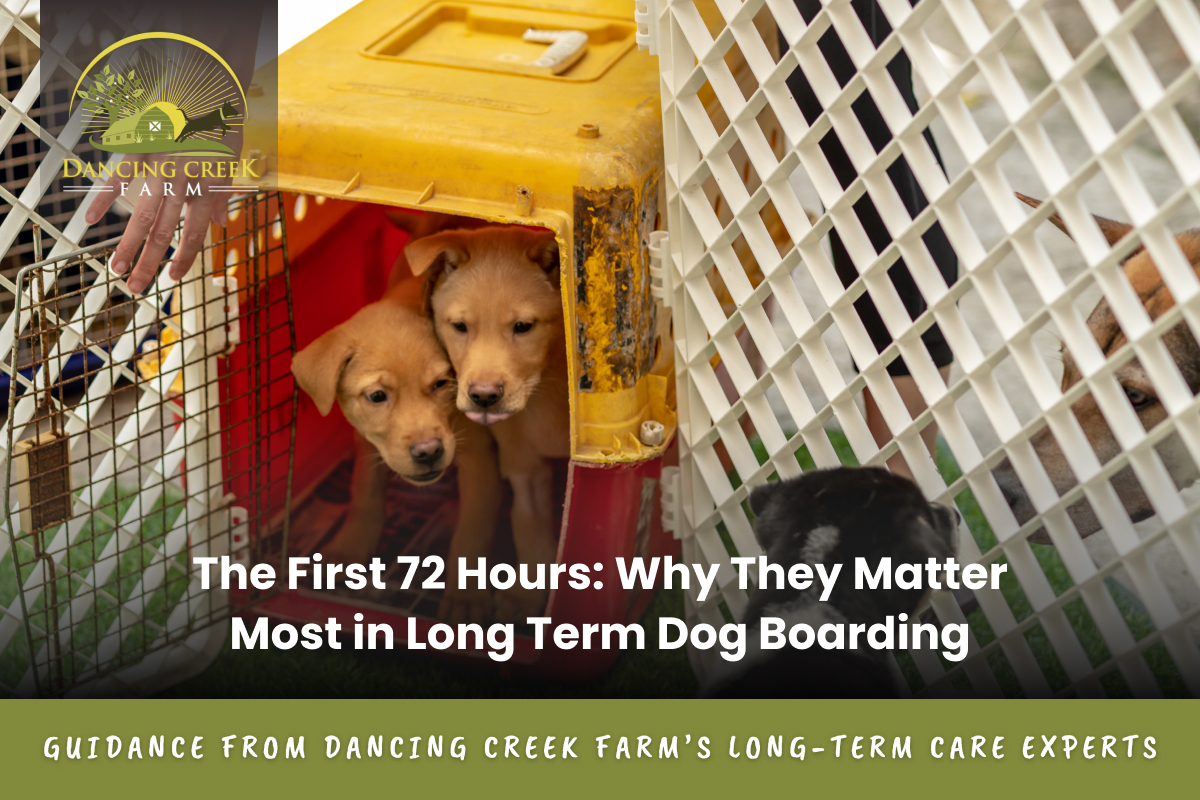
The First 72 Hours: Why They Matter Most in Long Term Dog Boarding

Long Term Dog Boarding

When dog owners prepare for Long Term Dog Boarding, they often focus on packing food, medications, toys, and blankets. While these are important, there is another factor that has an even greater impact on your dog’s stay, the first 72 hours.

Those first three days are when your dog begins to understand their new environment, build trust with caregivers, establish a routine, and adjust emotionally. A positive start during this period often leads to a happier, more relaxed boarding experience for the rest of their stay.

At Dancing Creek Farm, we have spent years caring for dogs with different personalities, ages, and backgrounds. One lesson has remained consistent: dogs that receive patience, structure, and individualized attention during their first 72 hours settle more quickly and enjoy their stay much more.

This guide explains why these first three days matter so much, what happens during the adjustment process, and how a thoughtful boarding program can make all the difference.

Why the First 72 Hours Are So Important

Dogs are creatures of habit. Their daily life usually follows a predictable routine, waking up, eating, walking, resting, and spending time with family.

When they arrive for long term dog boarding, almost everything changes:

  • New smells
  • New sounds
  • Different people
  • Different routines
  • New surroundings

Even confident dogs need time to process these changes.

The first 72 hours are essentially your dog’s transition period. During this time they begin answering important questions in their own way:

  • Am I safe?
  • Who are these people?
  • Where do I sleep?
  • When do I eat?
  • Can I relax here?

Once these questions are answered through consistent care, dogs become noticeably calmer.

Day One: Building Trust Instead of Excitement

The first day should never be rushed.

Some dogs arrive full of excitement.

Others may appear nervous, quiet, or clingy.

Both reactions are completely normal during the dog boarding adjustment period.

Instead of overwhelming dogs with constant activity, experienced caregivers focus on helping them feel secure.

This often includes:

  • Allowing time to explore
  • Introducing caregivers gradually
  • Maintaining a calm atmosphere
  • Offering water and meals without pressure
  • Providing quiet rest

The goal isn’t entertainment.

The goal is trust.

Day Two: Creating a Predictable Dog Boarding Routine

By the second day, dogs begin noticing patterns.

They learn when meals happen.

They recognize walking paths.

They remember caregivers.

They become familiar with resting areas.

This is where a structured dog boarding routine becomes incredibly valuable.

Routine reduces uncertainty.

Instead of wondering what happens next, dogs begin anticipating positive experiences.

That predictability lowers stress naturally.

Day Three: Confidence Starts to Grow

Around the third day, many dogs show remarkable changes.

Owners often worry their dog will remain anxious throughout the stay.

In reality, most healthy dogs begin relaxing once they understand their environment.

You may notice:

  • Better appetite
  • More relaxed body language
  • Interest in exploring
  • More playful behavior
  • Better sleep

This doesn’t happen by accident.

It happens because consistency builds confidence.

Every Dog Adjusts at Their Own Pace

One of the biggest misconceptions about first-time dog boarding is believing every dog adjusts the same way.

They don’t.

Some dogs settle within hours.

Others may need several days.

Factors include:

Age

Puppies may become excited quickly.

Senior dogs often need extra time.

Previous Experiences

Dogs with positive boarding experiences usually adjust faster.

Personality

Outgoing dogs explore sooner.

Reserved dogs observe quietly before engaging.

Training

Dogs accustomed to structure often transition more smoothly.

Good boarding programs recognize these differences instead of using a one-size-fits-all approach.

Why Farm Style Dog Boarding Makes Adjustment Easier

The environment itself plays a major role.

Traditional boarding facilities often expose dogs to:

  • Constant barking
  • Indoor confinement
  • Busy hallways
  • Frequent noise

In contrast, Farm Style Dog Boarding provides something many dogs naturally crave, space.

Natural surroundings encourage dogs to:

  • Walk calmly
  • Sniff
  • Observe wildlife
  • Relax outdoors
  • Explore safely

These activities reduce stress while satisfying natural canine instincts.

Instead of simply waiting for the day to pass, dogs remain mentally engaged.

Practical Example from Dancing Creek Farm

One family recently contacted Dancing Creek Farm before relocating overseas. Their three-year-old Labrador had never spent more than one night away from home, and the owners were understandably worried about how he would adjust to a longer stay.

During his first day, he ate very little and stayed close to the caregivers instead of exploring. Rather than forcing interaction, our team followed his pace. We kept his daily schedule consistent, gave him quiet time between activities, and encouraged gentle exploration of the farm.

By the second day, he began taking interest in walks around the property and responded positively to familiar routines like meal times and rest breaks.

On the third day, his behavior changed noticeably. He greeted caregivers with a wagging tail, explored confidently, and willingly participated in enrichment activities.

His owners later shared that the regular photo and video updates gave them peace of mind, and when they returned, they found a relaxed, confident dog rather than the anxious pet they had feared leaving behind.

Experiences like this remind us that the first 72 hours are not about rushing dogs into activities, they are about giving them the time, structure, and reassurance they need to feel safe.

Signs Your Dog Is Adjusting Well

Every dog shows progress differently, but positive signs include:

  • Eating regularly
  • Drinking water
  • Sleeping comfortably
  • Curious exploration
  • Relaxed posture
  • Tail wagging
  • Interest in caregivers
  • Calm interactions

These behaviors indicate growing confidence.

Signs That Require Extra Attention

Some dogs need additional support.

Experienced caregivers monitor:

  • Refusing food for extended periods
  • Excessive pacing
  • Continuous barking
  • Hiding
  • Digestive upset
  • Extreme lethargy

Most of these behaviors improve once dogs establish a routine, but careful observation ensures their health and well-being remain the top priority.

How Owners Can Help Before Boarding

Preparation begins long before drop-off.

You can make your dog’s transition easier by:

Keep Vaccinations Updated

Ensure all health requirements are completed before arrival.

Maintain Regular Feeding Habits

Avoid changing foods immediately before boarding.

Practice Short Separations

Leaving your dog with trusted friends or family for short periods can build confidence.

Pack Familiar Items

A favorite blanket or toy can provide comfort.

Stay Calm at Drop-Off

Dogs often reflect their owner’s emotions. A relaxed goodbye helps them feel secure.

Why Communication Matters

One hallmark of quality Long Term Dog Boarding is regular communication.

Updates allow owners to:

  • See how their dog is settling in.
  • Ask questions.
  • Feel reassured during longer stays.

At Dancing Creek Farm, we believe communication is part of great care. Sharing photos, videos, and progress updates helps families stay connected while giving them confidence that their dog is in capable hands.

Choosing the Right Boarding Facility

Not all boarding facilities manage the first 72 hours the same way.

Look for one that offers:

  • Individualized care plans
  • Experienced caregivers
  • Structured routines
  • Outdoor enrichment
  • Comfortable accommodations
  • Clear communication with owners
  • Safe exercise areas
  • Clean environment

These elements support both physical health and emotional well-being.

Final Thoughts

The first 72 hours are the foundation of a successful Long Term Dog Boarding experience. During this time, dogs begin building trust, adapting to a new routine, and gaining confidence in their surroundings.

With patience, consistency, and individualized care, what starts as an unfamiliar environment can quickly become a place where dogs feel safe, relaxed, and engaged.

At Dancing Creek Farm, we understand that every dog is unique. That’s why we focus on creating a calm, structured, and supportive transition from the very first day. Whether your dog is staying for a week or several months, those first three days receive the attention they deserve, because a strong start often leads to a happier, healthier boarding experience.


Frequently Asked Questions

How long does it take a dog to adjust to Long Term Dog Boarding?

Most dogs begin settling within the first 72 hours, although some may take a little longer depending on their personality, age, and previous boarding experiences.

Is it normal if my dog doesn’t eat on the first day?

Yes. Mild appetite changes during the first day are common as dogs adjust to a new environment. Most begin eating normally once they become familiar with their routine.

What should I pack for my dog’s boarding stay?

Pack your dog’s regular food, medications, feeding instructions, emergency contacts, and, if permitted, a familiar blanket or toy.

Why is a routine important during boarding?

A consistent dog boarding routine helps reduce uncertainty, lowers stress, and allows dogs to feel more secure in their new environment.

Does Farm Style Dog Boarding help reduce stress?

Yes. Open spaces, natural surroundings, structured activities, and a quieter environment often help dogs relax more quickly than traditional kennel settings.

Related Posts

Leaving your dog for several weeks or months can bring up one of the most emotional questions an owner can ask: “Will my dog forget me?”

It is a completely understandable concern. Dogs are part of the family, and their daily lives are often built around familiar people, routines, smells, and places. When that routine changes because of travel, military deployment, relocation, work, or another extended commitment, owners may worry that a long absence could weaken the bond they have built with their dog.

The good news is that long term dog boarding does not mean your dog simply forgets you.

Dogs can form strong attachments to people, and changes in a dog’s routine can affect behavior and emotions. However, a temporary separation is very different from permanently losing a familiar person. Dogs can adapt to a new routine while still maintaining their relationship with their owners.

The key is making sure the boarding experience provides safety, consistency, appropriate care, and enough positive interaction for the dog to feel secure while away.

Do Dogs Remember Their Owners After Long-Term Boarding?

Yes, dogs can recognize and remember familiar people after periods of separation.

Your dog does not need to see you every day to maintain familiarity with you. Your scent, voice, appearance, and the experiences you have shared all contribute to your relationship.

During long term dog boarding, your dog may become comfortable with new caregivers and develop a temporary routine that does not include you. That does not mean your dog has replaced you or forgotten the relationship you share.

In fact, becoming comfortable with caregivers can be a positive sign.

A dog that learns to relax, eat, sleep, exercise, and interact appropriately while boarding is demonstrating an ability to adapt to a temporary change.

Why Your Dog May Seem Different When You Pick Them Up

One thing that can surprise owners is their dog’s behavior at reunion.

Some dogs become extremely excited. They may jump, wag their tails, vocalize, or stay very close to their owner.

Other dogs may appear surprisingly calm.

That does not automatically mean the dog is no longer attached to you.

Dogs respond to reunions differently. Your dog may also be tired after travel, processing the change in routine, or simply transitioning from one environment back into another.

The important thing is to look at the overall relationship rather than interpreting one moment at pickup.

A dog that comfortably interacted with caregivers during boarding has not necessarily become less bonded to its family. It may simply have learned that it can feel safe with more than one trusted person.

A Healthy Boarding Routine Can Help Dogs Adjust

One of the most important parts of successful dog boarding adjustment is predictability.

Imagine your dog’s normal day at home.

There may be a familiar time for breakfast, walks, play, naps, bedtime, and interaction with family. When a dog enters a boarding environment, those familiar patterns change.

A thoughtful boarding program replaces uncertainty with a new routine.

That might include:

  • Consistent feeding times
  • Regular exercise
  • Predictable rest periods
  • Familiar caregivers
  • Safe outdoor activity
  • Comfortable sleeping arrangements
  • Individual attention
  • Monitoring of appetite and behavior

At Dancing Creek Farm, dogs stay in climate-controlled cabins with their own fenced yards, while the facility also provides larger fenced areas for exercise and enrichment. The farm emphasizes individualized care rather than treating every dog exactly the same.

For a dog staying several weeks or months, this consistency can become an important source of security.

Your Dog Can Be Happy Without Forgetting You

This is perhaps the most important distinction for worried owners.

A dog being comfortable at boarding is not evidence that your dog doesn’t miss you.

It is actually something owners should want.

If your dog cannot relax, eat, sleep, exercise, or interact with caregivers unless you are present, an extended separation can be much harder.

A good boarding experience gives dogs an opportunity to learn:

“My family is away, but I am still safe.”

That is very different from:

“My family no longer matters.”

The ability to adapt does not erase attachment.

What About Dogs With Separation Difficulties?

Some dogs have a particularly difficult time when separated from their owners. Others are naturally more independent.

This is one reason boarding facilities should evaluate dogs individually.

A dog’s age, temperament, previous experiences, social behavior, training, and familiarity with boarding can all influence how they respond to a new environment.

Owners should be honest during the intake process about behaviors such as:

  • Excessive distress when left alone
  • Destructive behavior
  • Persistent barking
  • Difficulty eating when separated
  • Previous negative boarding experiences
  • Fear of unfamiliar people
  • Reactivity toward dogs
  • Medical or behavioral concerns

At Dancing Creek Farm, owners are asked detailed questions about their dog’s temperament, interactions with other dogs, previous boarding or daycare experience, and why boarding is needed. This information helps the team understand the dog before the stay begins.

That individualized approach is particularly important for longer stays.

A Real Example From Dancing Creek Farm

One example that illustrates this well comes from a family whose dogs stayed at Dancing Creek Farm for five months.

According to the owner’s review, the dogs returned home healthy and happy after their extended stay. The family received regular pictures, allowing them to see how their dogs were doing throughout the boarding period.

What is particularly interesting is that the owner described the dogs as comfortable enough at the farm that they did not appear to be in a hurry to leave.

For an owner, that can initially sound almost contradictory:

“If my dog is happy there, does that mean they don’t need me anymore?”

No.

It means the dogs had successfully developed a sense of security in another environment.

The goal of quality long-term care is not to make dogs choose between their family and their caregivers. It is to help them feel safe while their family is temporarily away.

When the owners returned, the dogs could reconnect with their family while also having had a positive experience during the separation.

That is exactly the type of outcome owners should hope for.

How Owners Can Maintain the Bond During Boarding

You do not need to constantly communicate with your dog to preserve your relationship.

In fact, what matters most is the quality of the relationship you have built over time.

Before boarding, you can help by maintaining familiar habits and giving the boarding team accurate information about your dog’s routine.

You can also provide appropriate comfort items if the facility permits them.

At Dancing Creek Farm, communication is another important part of the experience. The farm says families can receive pictures and videos and can use communication options such as FaceTime or WhatsApp to stay connected.

These updates can be valuable for dog separation from the owner, particularly for the humans involved.

Sometimes the owner needs reassurance just as much as the dog needs care.

What Happens When Your Dog Comes Home?

The reunion is only one part of the transition.

After a long stay, your dog may need some time to readjust to home life.

You may notice temporary changes such as:

  • Sleeping more than usual
  • Being unusually excited
  • Wanting extra attention
  • Being slightly unsettled by changes in routine
  • Needing time to settle back into normal household patterns

Try not to expect your dog to immediately behave exactly as they did before boarding.

Instead, return to familiar routines gradually.

Feed meals at normal times, provide appropriate exercise, allow plenty of rest, and give your dog time to reconnect with the household.

The same principle that helps during dog boarding adjustment, predictability, can also help when your dog returns home.

Choosing the Right Boarding Environment Matters

Not every boarding experience is the same.

If your dog will be away for an extended period, look beyond the question of whether a facility has availability.

Ask:

  • How are dogs introduced to the environment?
  • Are individual temperaments considered?
  • Where will my dog sleep?
  • How much outdoor time is available?
  • What happens if my dog is uncomfortable around other dogs?
  • How often will staff interact with my dog?
  • How will behavioral or health concerns be communicated?
  • Will I receive updates during the stay?

At Dancing Creek Farm, dogs can have private cabins and fenced yards, including accommodations for dogs that are not comfortable in group settings. The farm also emphasizes experienced handlers, outdoor areas, enrichment, and communication with families.

For long stays, these details can make a meaningful difference.

Final Thoughts: Your Dog Doesn’t Need to Choose

The fear that your dog will forget you during Long Term Dog Boarding usually comes from a place of love.

You may imagine your dog wondering where you went, becoming attached to someone else, and eventually returning home as a completely different dog.

But a healthier way to think about boarding is this:

Your dog can learn to be comfortable without you while still loving and remembering you.

A successful boarding experience should give your dog stability during your absence, not replace the bond you share.

The goal is for your dog to have a safe, structured, positive experience while you are away and then comfortably transition back into life with you when you return.

At Dancing Creek Farm, the focus is on creating an environment where dogs can feel secure, receive individualized attention, maintain predictable routines, and enjoy their time away from home. For owners considering dog boarding in Virginia for an extended stay, choosing a facility that understands both the dog’s needs and the owner’s concerns can make the entire experience easier.

Your dog doesn’t have to forget you to enjoy their stay.

And you don’t have to feel guilty for giving them the opportunity to feel safe, confident, and cared for while you’re away.

Frequently Asked Questions

1. Will my dog forget me after long term boarding?

No. Dogs can maintain familiarity with and attachment to their owners even when separated for an extended period. A dog becoming comfortable with caregivers does not mean the relationship with its owner has disappeared.

2. How long does it take a dog to adjust to long term boarding?

Every dog is different. Some settle quickly, while others need several days or longer. Age, temperament, previous boarding experiences, and the dog’s ability to adapt to new routines can all influence the adjustment period.

3. Will my dog be sad while I am away?

Some dogs may show temporary signs of stress or changes in behavior when their routine changes. A consistent dog boarding routine, attentive caregivers, appropriate exercise, and a suitable environment can help many dogs adjust.

4. Should I stay in contact with my dog during long term boarding?

Owner updates can provide reassurance and help families feel connected. Dancing Creek Farm provides families with pictures and videos and offers communication options such as FaceTime or WhatsApp.

5. How can I make long term dog boarding easier for my dog?

Provide accurate information about your dog’s routine, temperament, food, medications, and previous experiences. Choose a boarding facility that individualizes care, maintains consistent routines, monitors behavior, and communicates with you throughout the stay.

Finding long-term dog boarding is very different from finding somewhere for your dog to stay for a weekend.

When you’ll be away for three months, six months, a year—or even several years—you need more than a traditional boarding kennel. You need a place where your dog can settle into a routine, receive individual attention, exercise, enrichment and experienced care while you’re away.

At Dancing Creek Farm in Danville, Virginia, long-term dog boarding has been one of our specialties since 2005.

For more than 20 years, families have trusted us with their dogs during military deployments, overseas assignments, extended travel, relocations, temporary housing situations, medical needs and other circumstances that make traditional short-term boarding impractical.

Our goal is simple: we want your dog to thrive while you’re away—not simply be boarded.

Long-Term Dog Boarding That Doesn’t Feel Like a Traditional Kennel

Dancing Creek Farm is located in the Virginia countryside, where dogs have room to enjoy being dogs.

Instead of a traditional kennel environment, we offer climate-controlled dog cabins, each with its own private fenced play yard. Dogs can enjoy fresh air and outdoor time while still having a comfortable, temperature-controlled indoor space.

Our farm also features large fenced pastures where dogs can stretch their legs, explore and enjoy full-on runs.

Daily care can include:

  • Individual attention from experienced dog handlers
  • Outdoor exercise and play
  • Canine enrichment activities
  • Fetch, sniffing and breed-appropriate activities
  • Large fenced areas for running and exploring
  • Premium nutrition
  • Supplements when appropriate
  • Rest and downtime
  • Lots of affection and human interaction

Most importantly, Dancing Creek Farm is staffed 24/7 by experienced dog handlers

For us, long-term boarding is about caring for the whole dog—physically, mentally and emotionally.

A Special Long-Term Boarding Setup for Small Dogs

Small dogs sometimes need a different environment than their larger counterparts.

Dancing Creek Farm has a special small-dog area adjoining the main house, allowing our team to provide closer supervision and a comfortable environment designed with little dogs in mind.

Whether your dog is staying for three months or three years, we work to create a routine that helps them feel secure and at home.

Affordable Monthly Dog Boarding for 3 Months to 3+ Years

Long-term boarding can become extremely expensive when calculated using standard daily kennel rates.

That’s why Dancing Creek Farm offers an affordable monthly long-term boarding option for dogs staying three months or longer.

Some dogs stay with us for a few months. Others stay six months, a year, or even one to three years or longer.

Every family’s situation is different, and our long-term program was designed around that reality.

Long-Term Dog Boarding With Transportation

Distance shouldn’t automatically prevent you from choosing the environment you want for your dog.

Dancing Creek Farm offers door-to-door dog transportation or halfway meeting options within approximately a 500-mile radius of Danville, Virginia

That makes our long-term boarding program accessible to families throughout Virginia and many areas of the East Coast and Mid-Atlantic.

Depending on your location and circumstances, our team can arrange to pick up your dog at your home or meet you partway.

Live More Than 500 Miles Away? We Have Options.

We regularly work with families traveling long distances or going overseas.

If you live outside our typical 500-mile transportation radius, contact us. We can help explore options that make getting your dog to Dancing Creek Farm easier.

One option is flying your dog into Raleigh-Durham International Airport (RDU), where arrangements can be made for our team to pick up your dog.

For customers driving to Dancing Creek Farm before an extended overseas trip, arrangements may also be available to leave your vehicle at the farm while we transport you to the airport.

Our goal is to remove as much of the logistical stress as possible—especially when you’re already preparing for a deployment, overseas assignment or major life transition.

Private WhatsApp Updates While You’re Away

Leaving your dog for months can be emotional, even when you know they’re in good hands.

That’s why our long-term customers are added to a private WhatsApp group with members of our team.

We share photos, videos and updates so you can see what your dog is doing and stay connected while you’re away.

For someone on the other side of the country—or the other side of the world—seeing their dog running through the pasture, relaxing in their cabin or enjoying time with our team can make the separation a little easier.

Military Deployment Dog Boarding

Military families have been an important part of Dancing Creek Farm since we opened in 2005.

We understand that deployments, training assignments and overseas orders can create a unique challenge:

Where will my dog live while I’m gone?

There are wonderful organizations helping military families find volunteer foster homes. One example is Dogs on Deployment, which operates the Hero Pet Boarding Network connecting eligible military pet owners with volunteer boarders.

Programs like these are an important resource and may be an excellent first option for qualifying families. However, volunteer availability isn’t guaranteed, and not every dog or situation ultimately results in a foster placement.

For families who cannot secure a volunteer foster—or who prefer a professional, staffed long-term boarding environment—Dancing Creek Farm offers another option.

Paws Waiting for Heroes

Through our Paws Waiting for Heroes program, we provide special long-term boarding discounts for deployed military members.

We are proud to give service members another dependable option when deployment means being separated from the dogs they love.

Our professional long-term boarding program provides consistency, 24/7 staffing, exercise, enrichment and ongoing communication throughout the dog’s stay.

We believe military families should be able to fulfill their service commitments without facing the heartbreaking possibility of giving up a beloved dog because they couldn’t find appropriate long-term care.

Why Families Choose Dancing Creek Farm for Long-Term Dog Boarding

Since 2005, thousands of dogs and their families have trusted Dancing Creek Farm.

Our 5-star reviews on Google and Facebook reflect something we’ve spent more than two decades building: relationships with families who want something different from traditional boarding.

We aren’t trying to recreate a standard kennel in the country.

We’ve created a farm environment where dogs can have space, structure, enrichment, experienced supervision and a routine of their own while their families are away.

Climate-controlled cabins. Private fenced yards. Huge fenced pastures. Experienced handlers. 24/7 staffing. Premium nutrition. Enrichment. Transportation options. Regular updates.

And most importantly, people who genuinely know and care about dogs.

Planning an Extended Trip, Deployment or Overseas Assignment?

Don’t wait until the last minute to arrange long-term care.

Whether you need long-term dog boarding for three months, six months, a year, several years or an uncertain amount of time, talk with us about your situation.

We work with families throughout Virginia and across the East Coast, and transportation options may make Dancing Creek Farm possible even when you live hundreds of miles away.

Your life may be taking you somewhere your dog can’t follow right now.

That doesn’t mean they can’t have a wonderful life while they wait for you to come home.

Learn more about long-term dog boarding, transportation and Dancing Creek Farm at:

dancingcreekfarm.com

Serving long-term boarding families from Danville, Virginia and throughout the East Coast since 2005.

When choosing a boarding facility, many dog owners assume that group boarding is automatically better because dogs are social animals. But that isn’t true for every dog.

Some dogs genuinely enjoy canine companionship. Others become overwhelmed, anxious, reactive, or uncomfortable when surrounded by unfamiliar dogs. For these dogs, forcing group interaction can create unnecessary stress rather than providing an enjoyable boarding experience.

A private dog boarding cabin can offer another option: personal space, controlled interaction, outdoor access, and a calmer daily routine.

At Dancing Creek Farm, we recognize that boarding should be based on the individual dog’s temperament rather than a one-size-fits-all approach. Our facility provides climate-controlled cabins with individual fenced yards, while dogs who are comfortable socially may share accommodations. Private cabins are available for dogs who are not social with other dogs or simply prefer their own space.

Why Group Boarding Doesn’t Work for Every Dog

Group boarding can be a wonderful experience for the right dog. A friendly, confident dog that enjoys playing with other dogs may benefit from supervised social interaction and companionship.

However, social compatibility is not determined simply by whether a dog has met other dogs before.

A dog may be:

  • Friendly with familiar dogs but uncomfortable with strangers
  • Easily overstimulated in busy environments
  • Protective of personal space
  • Nervous around unfamiliar dogs
  • Reactive when another dog approaches
  • Older and less interested in playing
  • More comfortable relaxing independently
  • Recovering from a stressful experience
  • Uncertain in a new environment

A dog that does not enjoy group settings should not be treated as though something is wrong with them.

The goal of boarding is not to make every dog social. The goal is to keep every dog safe, comfortable, and appropriately cared for.

What Is a Private Dog Boarding Cabin?

A private dog boarding cabin gives a dog its own dedicated space rather than requiring it to share sleeping quarters with unfamiliar dogs.

At Dancing Creek Farm, cabins are climate-controlled and have their own fenced yards. Dogs can move between the cabin and their individual outdoor area through a dog door, giving them opportunities to rest or spend time outside without being placed directly into a group environment.

This setup provides an important balance.

Your dog does not have to be isolated from people or activity simply because group boarding isn’t appropriate. Instead, the dog can have private accommodations while still receiving human attention, exercise, enrichment, and outdoor experiences.

That distinction matters.

Private does not have to mean lonely.

1. Private Cabins Can Help Reactive Dogs

One of the most important reasons owners consider private boarding is reactivity.

A reactive dog may bark, lunge, stiffen, growl, or become highly alert when another dog approaches. These behaviors don’t automatically mean the dog is dangerous, but they do indicate that the dog may not be comfortable in an uncontrolled social environment.

For these dogs, repeatedly placing them near unfamiliar dogs can increase arousal.

A private cabin can reduce unnecessary exposure and give caregivers greater control over the dog’s environment.

Dancing Creek Farm specifically offers private cabins for dog-reactive dogs, although the facility does not accept human-aggressive dogs.

This is an important distinction for owners: boarding arrangements should be based on honest temperament information and professional assessment, not on trying to force a dog into a social setting.

2. Some Dogs Simply Prefer Their Own Space

Not every dog that needs private boarding is reactive.

Some dogs simply prefer quiet.

Think about an older dog that enjoys sleeping for much of the day. Or a sensitive dog that becomes tired after interacting with unfamiliar animals. Or a dog accustomed to having its own sleeping area at home.

For these dogs, having a private cabin can make the transition into boarding easier.

Instead of constantly navigating other dogs, they have a predictable place where they can relax.

This is especially valuable during longer stays because the dog needs both activity and meaningful downtime.

Dancing Creek Farm’s boarding approach emphasizes individualized care, structured routines, exercise, enrichment, and private or social accommodation depending on the dog’s needs.

3. Older or Sensitive Dogs May Benefit From Privacy

Age can also influence a dog’s boarding preferences.

A senior dog may not want to participate in the same level of activity as a young, energetic dog. Even a socially friendly senior may appreciate having somewhere quiet to sleep after exercise.

Similarly, dogs with sensitive temperaments may need additional time to decompress after travel or unfamiliar experiences.

A private cabin allows caregivers to separate rest time from activity time.

That’s an important part of quality dog boarding. A good boarding experience isn’t about keeping a dog entertained every minute. Dogs need opportunities to sleep, observe their surroundings, relax, and follow a predictable routine.

4. Private Boarding Can Reduce Unnecessary Overstimulation

Imagine entering a room where several unfamiliar people are talking loudly, moving around, and constantly approaching you.

Now imagine doing that while you’re in an unfamiliar place and don’t understand when your family is coming back.

Some dogs experience a similar form of environmental overload when placed into a busy group setting.

Too much stimulation may result in:

  • Excessive barking
  • Pacing
  • Difficulty settling
  • Avoidance
  • Hyperactivity
  • Increased reactivity
  • Changes in appetite
  • Poor-quality rest

A calmer environment can give a dog more opportunities to regulate its behavior.

This doesn’t mean private boarding will eliminate anxiety or behavioral problems. Rather, it can remove one potential source of unnecessary pressure.

5. Private Does Not Mean No Exercise

One common misconception is that a dog staying privately will spend the entire boarding stay alone in a cabin.

That shouldn’t be the goal.

A quality private boarding arrangement should still provide appropriate movement, enrichment, and human interaction.

At Dancing Creek Farm, dogs have access to individual fenced yards as well as larger fenced pastures for exercise and play. Staff also provide interaction and enrichment based on each dog’s needs.

This creates what can be thought of as structured freedom.

The dog gets personal space when it needs to decompress, while still having opportunities to explore, exercise, interact with handlers, and participate in appropriate activities.

A Realistic Example: When Private Space Makes a Difference 

At Dancing Creek Farm, we’ve seen that not every dog feels comfortable sharing space with unfamiliar dogs. For example, when a dog arrives for boarding and the owner tells us that the dog tends to avoid other dogs or becomes uncomfortable when they get too close, we don’t believe the answer is to simply put that dog into a group and hope it adjusts. Instead, we look at the dog’s temperament and daily needs and consider whether a private cabin would provide a better experience. With a private, climate-controlled cabin and its own fenced yard, the dog can have time to relax, get individual attention from our team, enjoy appropriate outdoor activity, and settle into a routine without the added pressure of unfamiliar dogs sharing its space. Over the years, we’ve learned that a successful boarding stay isn’t about making every dog social. It’s about understanding what helps that particular dog feel secure, comfortable, and settled while they’re away from home. 

Private Boarding Can Also Help Multi-Dog Families

Private cabins aren’t only useful for individual dogs.

Some families have multiple dogs that are comfortable living together but should not necessarily be mixed with unfamiliar dogs.

At Dancing Creek Farm, up to three dogs from the same household may share a private cabin under the applicable long-term boarding arrangement.

This can provide the benefits of companionship without introducing unfamiliar dogs into the equation.

For a bonded family group, staying together may also make an unfamiliar environment feel more familiar.

How Do You Know If Your Dog Needs Private Boarding?

Ask yourself a few simple questions before booking:

Does my dog enjoy unfamiliar dogs?

Being friendly with one neighbor’s dog doesn’t necessarily mean your dog enjoys group boarding.

Has my dog ever shown reactivity?

Barking, lunging, stiff body language, snapping, or intense fixation around other dogs should be discussed honestly with the boarding provider.

Does my dog prefer quiet environments?

If your dog routinely walks away from groups to sleep or relax, private accommodation may be worth considering.

Is my dog older or easily overwhelmed?

Age, energy level, and temperament should all influence boarding decisions.

What happens when my dog feels pressured?

Understanding your dog’s behavior under stress can help caregivers create a safer plan.

A responsible boarding facility should ask questions about temperament, previous boarding experiences, daycare exposure, dog parks, and interactions with other dogs. Dancing Creek Farm’s reservation process specifically asks owners about their dog’s temperament and experience in social settings before determining appropriate accommodations.

Private vs. Group Boarding: Which Is Better?

Neither option is universally better.

Group boarding may be appropriate for:

  • Social, confident dogs
  • Dogs that enjoy canine companionship
  • Dogs with positive group experiences
  • Dogs that can comfortably share space

Private boarding may be better for:

  • Dog-reactive dogs
  • Dogs that dislike unfamiliar dogs
  • Dogs that prefer personal space
  • Older or sensitive dogs
  • Dogs that become overstimulated
  • Dogs from the same household that need to stay together privately

The right question isn’t, “Which boarding option is best?”

The better question is:

“Which boarding environment is best for my individual dog?”

What Owners Should Ask Before Choosing a Boarding Facility

Before booking, ask the facility:

  1. How do you determine whether dogs can share accommodations?
  2. What happens if my dog becomes uncomfortable around another dog?
  3. Are private accommodations available?
  4. Does private boarding include outdoor access?
  5. How much human interaction does my dog receive?
  6. How is exercise handled?
  7. Are staff present overnight?
  8. What information do you collect about my dog’s temperament?

These questions can reveal whether a facility truly individualizes its care or simply places every dog into the same routine.

At Dancing Creek Farm, dogs are accommodated according to social temperament, with private cabins available for dogs that need their own space. The farm also provides 24/7 on-site staff and individual fenced yards attached to cabins.

Final Thoughts

The best dog boarding experience isn’t necessarily the most social one.

Some dogs thrive around other dogs. Others thrive when they have space, quiet, predictable routines, and carefully managed interactions.

For a reactive, unsocial, older, sensitive, or easily overstimulated dog, a private dog boarding cabin can provide an important layer of comfort and control without sacrificing exercise, enrichment, or human attention.

At Dancing Creek Farm, the philosophy is simple: every dog deserves care that fits the dog, not a generic boarding model.

If your dog doesn’t enjoy group settings, that doesn’t mean you have to compromise on quality boarding. It means you should look for a facility that understands individual temperament and can provide an environment designed around your dog’s actual needs.

FAQs

1. Is private boarding better for reactive dogs?

Private boarding can be a better option for dogs that are reactive or uncomfortable around unfamiliar dogs because it can reduce unnecessary social pressure. The dog’s full temperament and behavior should always be discussed with the boarding provider beforehand.

2. Can my dog get enough exercise in a private boarding cabin?

Yes. Private accommodation doesn’t have to mean limited activity. Facilities may provide individual yards, walks, enrichment, and supervised access to larger exercise areas depending on the dog’s needs.

3. Does my dog need to be aggressive to need private boarding?

No. A dog can be friendly with people and still prefer not to share space with unfamiliar dogs. Some dogs simply need more personal space or become overwhelmed by group environments.

4. Can two or more dogs from the same family stay in a private cabin?

Some facilities allow compatible dogs from the same household to share private accommodations. Dancing Creek Farm, for example, allows up to three dogs from the same family to share a private cabin under its long-term boarding arrangements.

5. How do I know whether my dog should have private or group boarding?

Consider your dog’s history with unfamiliar dogs, reactivity, age, energy level, social preferences, and ability to settle around other animals. A reputable boarding facility should also ask detailed temperament questions before deciding which accommodation is appropriate.