When choosing a boarding facility, many dog owners assume that group boarding is automatically better because dogs are social animals. But that isn’t true for every dog.
Some dogs genuinely enjoy canine companionship. Others become overwhelmed, anxious, reactive, or uncomfortable when surrounded by unfamiliar dogs. For these dogs, forcing group interaction can create unnecessary stress rather than providing an enjoyable boarding experience.
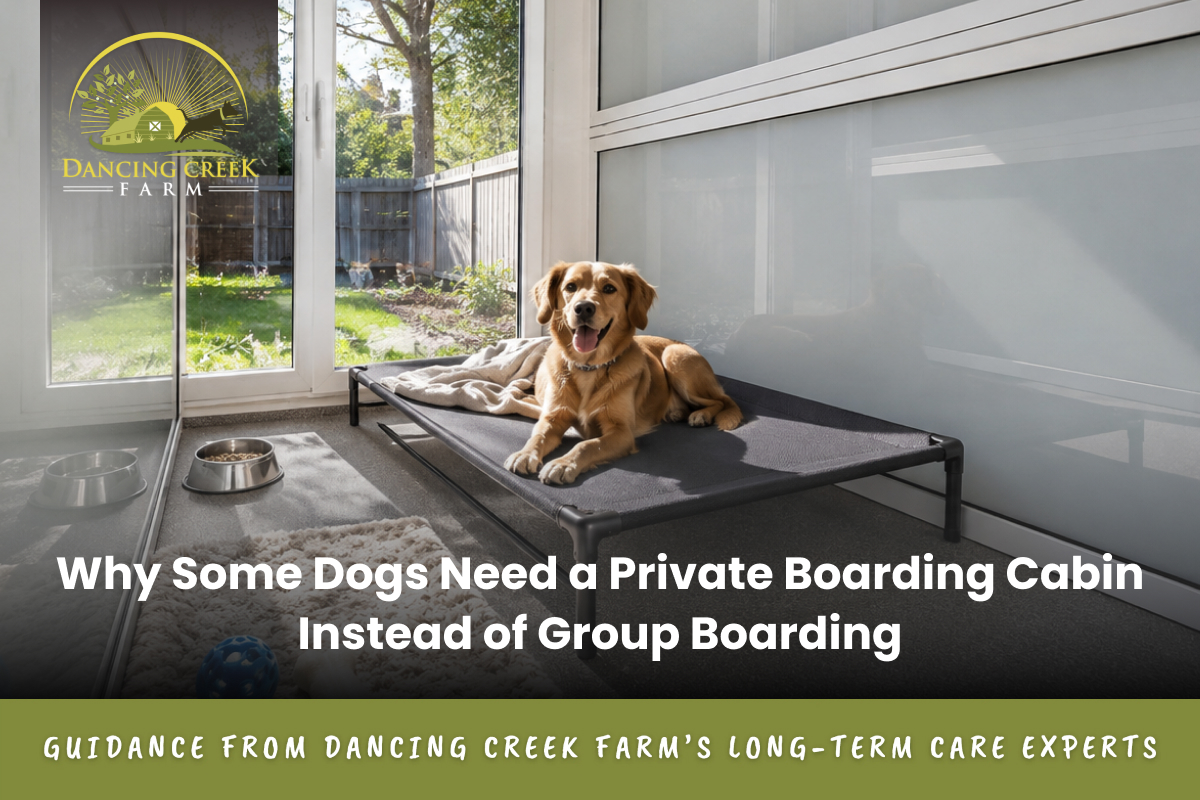
A private dog boarding cabin can offer another option: personal space, controlled interaction, outdoor access, and a calmer daily routine.
At Dancing Creek Farm, we recognize that boarding should be based on the individual dog’s temperament rather than a one-size-fits-all approach. Our facility provides climate-controlled cabins with individual fenced yards, while dogs who are comfortable socially may share accommodations. Private cabins are available for dogs who are not social with other dogs or simply prefer their own space.
Why Group Boarding Doesn’t Work for Every Dog
Group boarding can be a wonderful experience for the right dog. A friendly, confident dog that enjoys playing with other dogs may benefit from supervised social interaction and companionship.
However, social compatibility is not determined simply by whether a dog has met other dogs before.
A dog may be:
- Friendly with familiar dogs but uncomfortable with strangers
- Easily overstimulated in busy environments
- Protective of personal space
- Nervous around unfamiliar dogs
- Reactive when another dog approaches
- Older and less interested in playing
- More comfortable relaxing independently
- Recovering from a stressful experience
- Uncertain in a new environment
A dog that does not enjoy group settings should not be treated as though something is wrong with them.
The goal of boarding is not to make every dog social. The goal is to keep every dog safe, comfortable, and appropriately cared for.
What Is a Private Dog Boarding Cabin?
A private dog boarding cabin gives a dog its own dedicated space rather than requiring it to share sleeping quarters with unfamiliar dogs.
At Dancing Creek Farm, cabins are climate-controlled and have their own fenced yards. Dogs can move between the cabin and their individual outdoor area through a dog door, giving them opportunities to rest or spend time outside without being placed directly into a group environment.
This setup provides an important balance.
Your dog does not have to be isolated from people or activity simply because group boarding isn’t appropriate. Instead, the dog can have private accommodations while still receiving human attention, exercise, enrichment, and outdoor experiences.
That distinction matters.
Private does not have to mean lonely.
1. Private Cabins Can Help Reactive Dogs
One of the most important reasons owners consider private boarding is reactivity.
A reactive dog may bark, lunge, stiffen, growl, or become highly alert when another dog approaches. These behaviors don’t automatically mean the dog is dangerous, but they do indicate that the dog may not be comfortable in an uncontrolled social environment.
For these dogs, repeatedly placing them near unfamiliar dogs can increase arousal.
A private cabin can reduce unnecessary exposure and give caregivers greater control over the dog’s environment.
Dancing Creek Farm specifically offers private cabins for dog-reactive dogs, although the facility does not accept human-aggressive dogs.
This is an important distinction for owners: boarding arrangements should be based on honest temperament information and professional assessment, not on trying to force a dog into a social setting.
2. Some Dogs Simply Prefer Their Own Space
Not every dog that needs private boarding is reactive.
Some dogs simply prefer quiet.
Think about an older dog that enjoys sleeping for much of the day. Or a sensitive dog that becomes tired after interacting with unfamiliar animals. Or a dog accustomed to having its own sleeping area at home.
For these dogs, having a private cabin can make the transition into boarding easier.
Instead of constantly navigating other dogs, they have a predictable place where they can relax.
This is especially valuable during longer stays because the dog needs both activity and meaningful downtime.
Dancing Creek Farm’s boarding approach emphasizes individualized care, structured routines, exercise, enrichment, and private or social accommodation depending on the dog’s needs.
3. Older or Sensitive Dogs May Benefit From Privacy
Age can also influence a dog’s boarding preferences.
A senior dog may not want to participate in the same level of activity as a young, energetic dog. Even a socially friendly senior may appreciate having somewhere quiet to sleep after exercise.
Similarly, dogs with sensitive temperaments may need additional time to decompress after travel or unfamiliar experiences.
A private cabin allows caregivers to separate rest time from activity time.
That’s an important part of quality dog boarding. A good boarding experience isn’t about keeping a dog entertained every minute. Dogs need opportunities to sleep, observe their surroundings, relax, and follow a predictable routine.
4. Private Boarding Can Reduce Unnecessary Overstimulation
Imagine entering a room where several unfamiliar people are talking loudly, moving around, and constantly approaching you.
Now imagine doing that while you’re in an unfamiliar place and don’t understand when your family is coming back.
Some dogs experience a similar form of environmental overload when placed into a busy group setting.
Too much stimulation may result in:
- Excessive barking
- Pacing
- Difficulty settling
- Avoidance
- Hyperactivity
- Increased reactivity
- Changes in appetite
- Poor-quality rest
A calmer environment can give a dog more opportunities to regulate its behavior.
This doesn’t mean private boarding will eliminate anxiety or behavioral problems. Rather, it can remove one potential source of unnecessary pressure.
5. Private Does Not Mean No Exercise
One common misconception is that a dog staying privately will spend the entire boarding stay alone in a cabin.
That shouldn’t be the goal.
A quality private boarding arrangement should still provide appropriate movement, enrichment, and human interaction.
At Dancing Creek Farm, dogs have access to individual fenced yards as well as larger fenced pastures for exercise and play. Staff also provide interaction and enrichment based on each dog’s needs.
This creates what can be thought of as structured freedom.
The dog gets personal space when it needs to decompress, while still having opportunities to explore, exercise, interact with handlers, and participate in appropriate activities.
A Realistic Example: When Private Space Makes a Difference
At Dancing Creek Farm, we’ve seen that not every dog feels comfortable sharing space with unfamiliar dogs. For example, when a dog arrives for boarding and the owner tells us that the dog tends to avoid other dogs or becomes uncomfortable when they get too close, we don’t believe the answer is to simply put that dog into a group and hope it adjusts. Instead, we look at the dog’s temperament and daily needs and consider whether a private cabin would provide a better experience. With a private, climate-controlled cabin and its own fenced yard, the dog can have time to relax, get individual attention from our team, enjoy appropriate outdoor activity, and settle into a routine without the added pressure of unfamiliar dogs sharing its space. Over the years, we’ve learned that a successful boarding stay isn’t about making every dog social. It’s about understanding what helps that particular dog feel secure, comfortable, and settled while they’re away from home.
Private Boarding Can Also Help Multi-Dog Families
Private cabins aren’t only useful for individual dogs.
Some families have multiple dogs that are comfortable living together but should not necessarily be mixed with unfamiliar dogs.
At Dancing Creek Farm, up to three dogs from the same household may share a private cabin under the applicable long-term boarding arrangement.
This can provide the benefits of companionship without introducing unfamiliar dogs into the equation.
For a bonded family group, staying together may also make an unfamiliar environment feel more familiar.
How Do You Know If Your Dog Needs Private Boarding?
Ask yourself a few simple questions before booking:
Does my dog enjoy unfamiliar dogs?
Being friendly with one neighbor’s dog doesn’t necessarily mean your dog enjoys group boarding.
Has my dog ever shown reactivity?
Barking, lunging, stiff body language, snapping, or intense fixation around other dogs should be discussed honestly with the boarding provider.
Does my dog prefer quiet environments?
If your dog routinely walks away from groups to sleep or relax, private accommodation may be worth considering.
Is my dog older or easily overwhelmed?
Age, energy level, and temperament should all influence boarding decisions.
What happens when my dog feels pressured?
Understanding your dog’s behavior under stress can help caregivers create a safer plan.
A responsible boarding facility should ask questions about temperament, previous boarding experiences, daycare exposure, dog parks, and interactions with other dogs. Dancing Creek Farm’s reservation process specifically asks owners about their dog’s temperament and experience in social settings before determining appropriate accommodations.
Private vs. Group Boarding: Which Is Better?
Neither option is universally better.
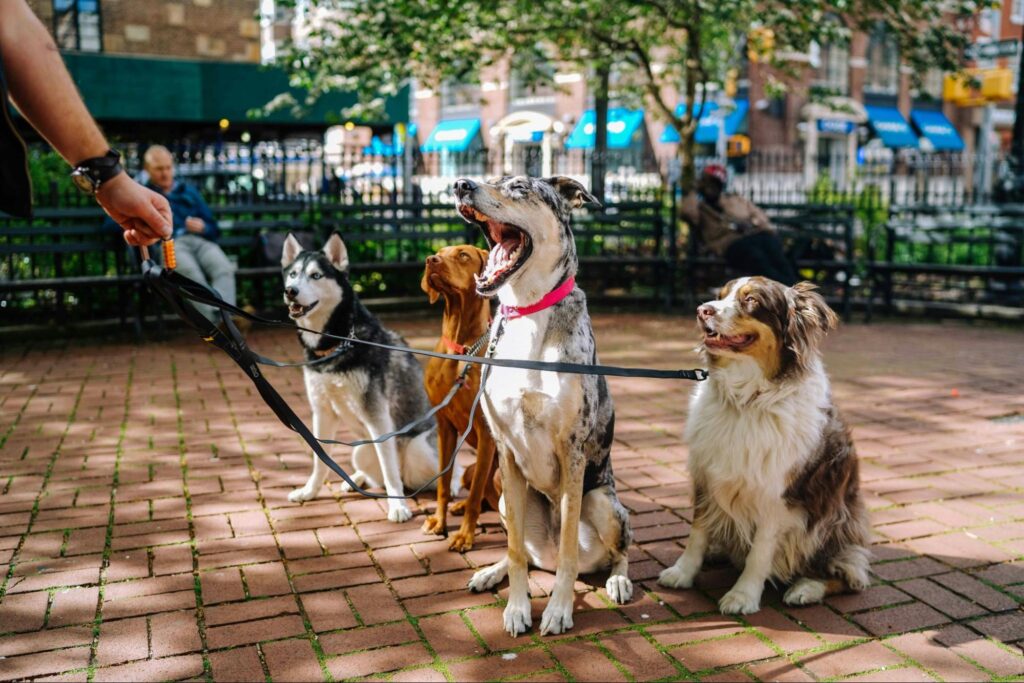
Group boarding may be appropriate for:
- Social, confident dogs
- Dogs that enjoy canine companionship
- Dogs with positive group experiences
- Dogs that can comfortably share space
Private boarding may be better for:
- Dog-reactive dogs
- Dogs that dislike unfamiliar dogs
- Dogs that prefer personal space
- Older or sensitive dogs
- Dogs that become overstimulated
- Dogs from the same household that need to stay together privately
The right question isn’t, “Which boarding option is best?”
The better question is:
“Which boarding environment is best for my individual dog?”
What Owners Should Ask Before Choosing a Boarding Facility
Before booking, ask the facility:
- How do you determine whether dogs can share accommodations?
- What happens if my dog becomes uncomfortable around another dog?
- Are private accommodations available?
- Does private boarding include outdoor access?
- How much human interaction does my dog receive?
- How is exercise handled?
- Are staff present overnight?
- What information do you collect about my dog’s temperament?
These questions can reveal whether a facility truly individualizes its care or simply places every dog into the same routine.
At Dancing Creek Farm, dogs are accommodated according to social temperament, with private cabins available for dogs that need their own space. The farm also provides 24/7 on-site staff and individual fenced yards attached to cabins.
Final Thoughts
The best dog boarding experience isn’t necessarily the most social one.
Some dogs thrive around other dogs. Others thrive when they have space, quiet, predictable routines, and carefully managed interactions.
For a reactive, unsocial, older, sensitive, or easily overstimulated dog, a private dog boarding cabin can provide an important layer of comfort and control without sacrificing exercise, enrichment, or human attention.
At Dancing Creek Farm, the philosophy is simple: every dog deserves care that fits the dog, not a generic boarding model.
If your dog doesn’t enjoy group settings, that doesn’t mean you have to compromise on quality boarding. It means you should look for a facility that understands individual temperament and can provide an environment designed around your dog’s actual needs.
FAQs
1. Is private boarding better for reactive dogs?
Private boarding can be a better option for dogs that are reactive or uncomfortable around unfamiliar dogs because it can reduce unnecessary social pressure. The dog’s full temperament and behavior should always be discussed with the boarding provider beforehand.
2. Can my dog get enough exercise in a private boarding cabin?
Yes. Private accommodation doesn’t have to mean limited activity. Facilities may provide individual yards, walks, enrichment, and supervised access to larger exercise areas depending on the dog’s needs.
3. Does my dog need to be aggressive to need private boarding?
No. A dog can be friendly with people and still prefer not to share space with unfamiliar dogs. Some dogs simply need more personal space or become overwhelmed by group environments.
4. Can two or more dogs from the same family stay in a private cabin?
Some facilities allow compatible dogs from the same household to share private accommodations. Dancing Creek Farm, for example, allows up to three dogs from the same family to share a private cabin under its long-term boarding arrangements.
5. How do I know whether my dog should have private or group boarding?
Consider your dog’s history with unfamiliar dogs, reactivity, age, energy level, social preferences, and ability to settle around other animals. A reputable boarding facility should also ask detailed temperament questions before deciding which accommodation is appropriate.