

What You Need To Know
- Most healthy adult dogs need 30 minutes to 2 hours of exercise a day, split into two or more sessions.
- Puppies follow the “five minutes per month of age, up to twice a day” rule of thumb.
- High-energy and working breeds often need 2 hours or more; flat-faced and senior dogs need shorter, gentler sessions.
- Mental exercise counts. Sniffing, training, and puzzle feeders tire a dog out too.
- Chewing, barking, and jumping on guests often mean too little exercise. Limping and next-day stiffness mean too much.
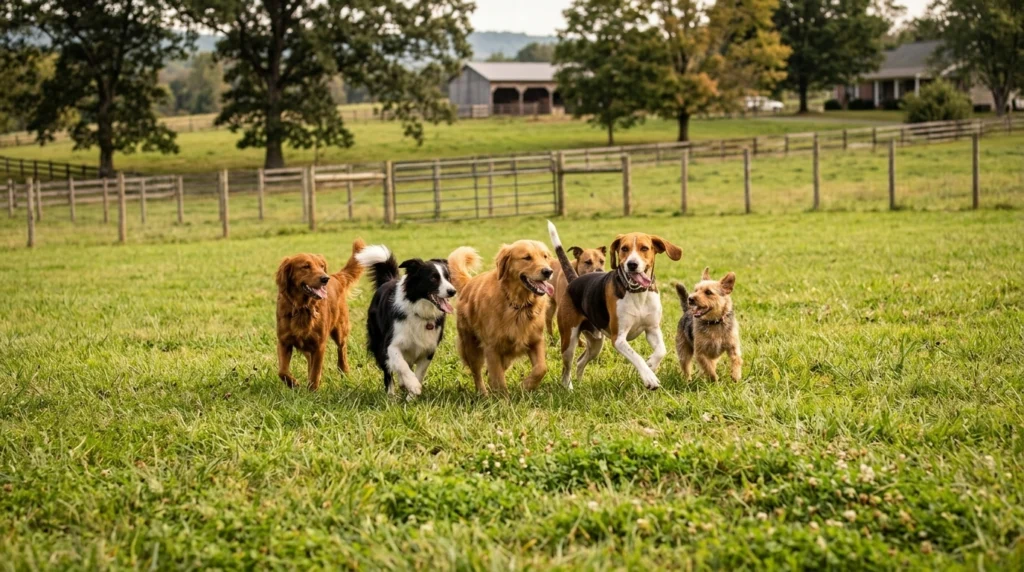
How much exercise does a dog need each day? It’s one of the first questions new owners ask us, and the honest answer is “more than most dogs get.” We’ve boarded and trained dogs at our farm in Cascade, Virginia, since 2005, and we see the same pattern every week.
A dog arrives wound up, chewing, barking, or bouncing off visitors. A few days of real daily activity in our pastures, and that same dog is calmer and easier to train. Exercise isn’t a bonus. It’s the foundation everything else sits on.
How much exercise does a dog need each day?
Most healthy adult dogs need between 30 minutes and 2 hours of exercise every day. Elanco’s veterinary guide (reviewed December 2022) gives that same range, adjusted for size, age, health, and breed. Low-energy breeds sit near the bottom, while herding, sporting, and working dogs sit at the top or above it.
Here’s the thing: what happens during those minutes matters more than the clock. Thirty minutes of sniffing, trotting, and practicing commands tires a dog more than an hour of slow loops around the same block.
Think of your dog’s energy like a phone battery. It recharges every night, and if nothing drains it during the day, it finds its own outlet. Usually that outlet is your couch cushions.
How do age, breed, and size change dog exercise needs?
Age, breed, and size are the three biggest factors in dog exercise needs. The American Kennel Club (updated August 2026) says the answer varies with age, health, and breed.
The table below pulls the most cited ranges into one place.
| Dog type | Daily exercise (rough guide) | Best kinds of activity | Source |
|---|---|---|---|
| Puppy | 5 minutes per month of age, up to twice a day | Short walks, free play, early training | UK Kennel Club rule |
| Typical adult | 30 minutes to 2 hours | Walks, fetch, training, sniff time | Elanco |
| High-energy or working breed | 2 hours or more | Running, hiking, herding, dog sports | Elanco |
| Giant breed | 20 to 30 minute sessions, 2 to 3 times a day | Steady walks, swimming | Rover |
| Flat-faced breed | 10 to 15 minute sessions, 2 to 3 times a day | Cool-hour strolls, indoor games | Rover |
| Senior dog | 10 to 20 minute sessions, 2 to 3 times a day | Gentle walks, swimming, sniffing | Rover |
Treat these as starting points, not prescriptions. Your dog’s body condition and behavior will tell you whether to add time or pull back.
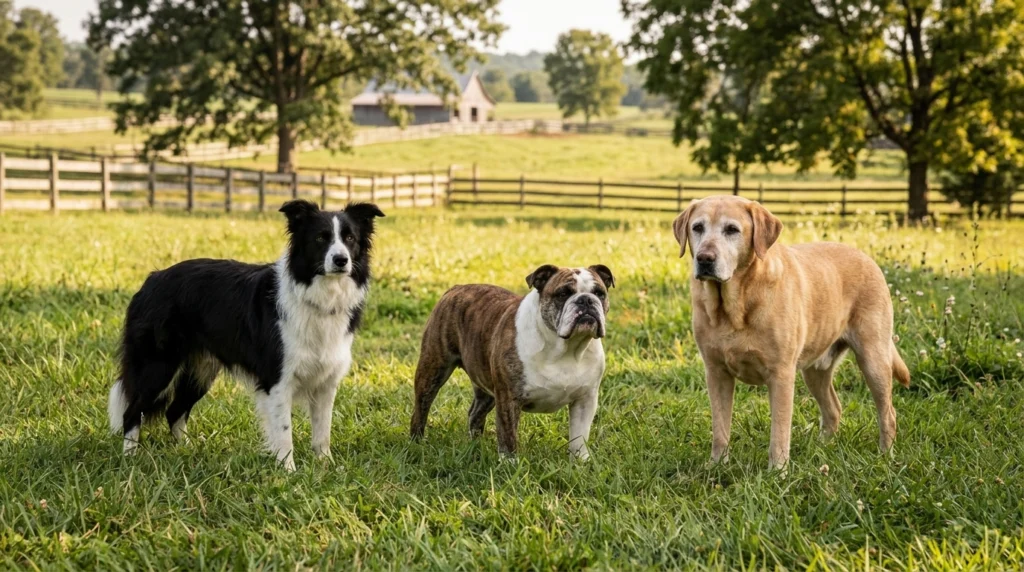
How much exercise does a puppy need?
A puppy needs short, frequent bursts of exercise rather than one long outing. The UK Kennel Club’s rule of thumb, quoted in Dogster’s vet-reviewed guide, is five minutes per month of age, up to twice a day, until fully grown.
That means about 15 minutes per session at three months and 20 at four months. Picture a puppy’s joints like fresh concrete: still setting, and easy to dent if loaded too early. Free play on soft ground is fine. Forced marches and long jogs aren’t.
How much exercise does an adult dog need?
An adult dog needs at least one walk a day, and most do better with two or more outings. GoodRx’s vet-reviewed guide says active breeds like the Border Collie need far more than a Basset Hound.
Breed sets the ceiling. A Labrador, Australian Shepherd, or Husky was bred to work long days. A Shih Tzu was bred for company. Neither is wrong; they just need different days.
How much exercise does a senior dog need?
A senior dog needs regular daily exercise in shorter, gentler sessions. Movement keeps aging joints loose and weight down, but stairs, long hikes, and repeated ball chasing can aggravate arthritis. The American Kennel Club recommends talking with your vet about a senior’s routine.
We’d swap one long walk for two or three short ones and let the dog set the pace. Grass and trails are kinder than pavement. If your older dog seems stiff the next morning, shorten the next walk.
What counts as exercise for a dog?
Exercise for a dog is any activity that works the body, the brain, or both. Physical activity burns one kind of energy. Mental exercise burns another, and most owners underestimate it.
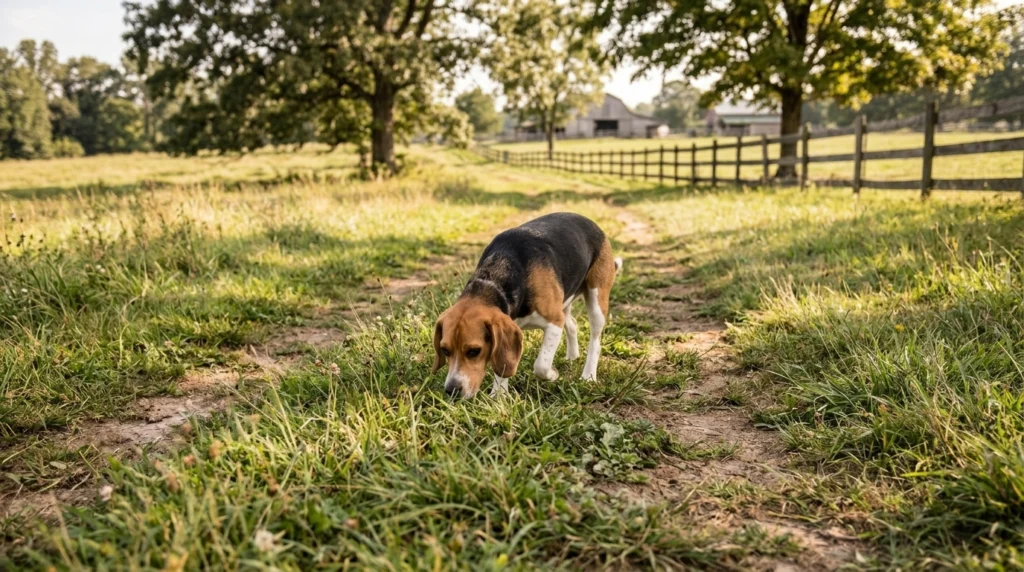
Sniffing is the big one. Following a scent trail is like handing a person a tough crossword: they’re barely moving, but the brain is working hard. Ten minutes of nose work can settle a dog almost as well as a brisk walk.
Good options to mix into a daily exercise routine:
- Walks and hikes: the baseline for almost every dog.
- Fetch and tug: quick, intense bursts for dogs who love to chase.
- Swimming: low-impact work for dogs with arthritis or extra weight.
- Sniff walks: slow, nose-led walks where the dog picks the route.
- Training sessions: obedience, tricks, and recall all count as mental exercise.
- Puzzle feeders: turn mealtime into a problem to solve.
Training is our favorite way to stack both kinds of work into one session. Our balanced dog training programs use short, focused drills that leave dogs tired in the good way.
At home, practicing the 7 basic dog commands every dog should know makes an easy five-minute add-on to any walk.
What are the signs your dog isn’t getting enough exercise?
The clearest signs your dog isn’t getting enough exercise are restlessness, destructive chewing, excessive barking, and weight gain. Most of these show up as “behavior problems” long before anyone links them to a lack of activity.
Watch for:
- Weight gain: the Association for Pet Obesity Prevention found 59% of dogs assessed by U.S. veterinary teams in its 2022 survey were overweight or had obesity.
- Chewing or digging: energy looking for a job.
- Barking or pacing: especially in the evening.
- Jumping on people: an under-exercised dog greets guests like a shaken soda can. Our guide on how to stop a dog from jumping works far better once the energy is handled.
- Leash pulling: see our tips on how to stop a dog pulling on the leash.
Research backs up what we see.
A 2015 PLOS ONE study of 3,264 Finnish dogs found daily exercise was the largest environmental factor tied to noise sensitivity and separation anxiety.
A 2020 University of Helsinki study found the most active, actively trained dogs were the least fearful.
One honest caveat: these studies show a link, not proof that exercise alone fixes anxiety. Fearful dogs may simply get taken out less. If fear is part of your picture, read our piece on fear and reactivity in dogs.
Can a dog get too much exercise?
Yes, a dog can get too much exercise, especially puppies, seniors, flat-faced breeds, and any dog working hard in the heat. Over-exercise strains joints and paw pads and can lead to dehydration or heatstroke.
Signs of too much, drawn from the Elanco and GoodRx guides:
- Limping, stiffness, or soreness the next day
- Lagging behind or refusing to continue
- Raw or worn paw pads
- Heavy panting, dry gums, vomiting, or weakness (call your vet right away for possible heatstroke)
Virginia summers are humid, so we move hard play to early morning and evening from June through August. In cold snaps, small and short-coated dogs need shorter outings; our winter dog care tips cover that side.
How do you build a daily exercise routine that sticks?
Build a daily exercise routine by matching the plan to your dog, splitting it into sessions, and mixing body and brain work. Here’s the process we walk owners through:
- Start with your dog’s type. Use the table above to set a realistic daily target.
- Split it up. Two or three sessions beat one marathon for almost every dog.
- Mix the work. Pair each walk with five minutes of training or a sniff break.
- Watch the results for two weeks. Calmer evenings mean you’re close. Chewing or sore legs mean adjust.
- Check with your vet before big changes for puppies, seniors, or dogs with health issues.
If weight is the main concern, pair exercise with diet; our notes on holistic dog nutrition are a good start.
How do we keep dogs exercised at Dancing Creek Farm?
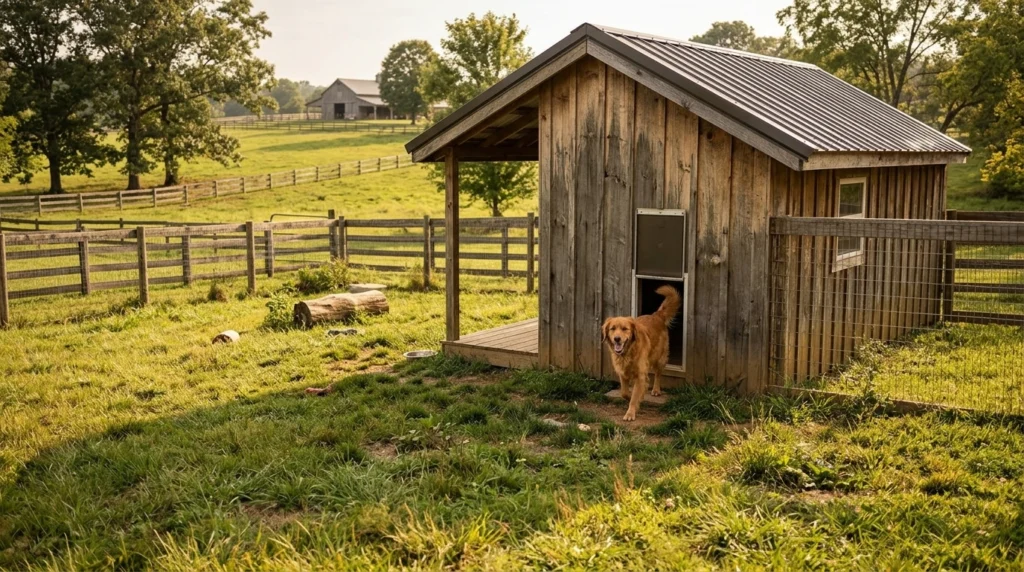
We keep boarding dogs active with pasture play, private yards, and optional one-on-one walks. Every cabin has its own fenced yard with a dog door, so dogs go in and out whenever they like.
Social dogs play in groups matched by size, age, and temperament, with staff on site around the clock. Dogs who prefer their own space get private cabins. Owners can add farm nature walks, sniff and explore time, or obstacle yard confidence work.
Traveling soon? See our short-term dog boarding in Virginia or long-term dog boarding for extended stays.
Questions? Reach out to our team or call 434-549-1616.
Frequently asked questions
Is a 30 minute walk enough exercise for a dog?
A 30 minute walk is enough for many small, low-energy, or senior dogs, but rarely for a healthy sporting, herding, or working breed. PetMD notes most dogs in good body condition can handle a daily 20 to 30 minute walk. For active breeds, treat 30 minutes as the floor, then add play or a second walk.
How many walks a day does a dog need?
Most adult dogs do best with two walks a day, and many benefit from three. Splitting exercise keeps energy steady and gives more chances to sniff. Puppies need several short outings, while seniors often prefer two or three easy strolls. Very low-energy dogs can manage on one walk plus play at home.
Is it okay to skip a dog’s walk some days?
Skipping a walk occasionally is fine during extreme heat, storms, or recovery from illness. On those days, swap in indoor work: hide and seek, a puzzle feeder, tug, or a short training session. The weekly pattern matters most. One missed walk is fine; missing most of them shows up in behavior and weight.
How can you tell if your dog is getting the right amount of exercise?
Your dog is getting the right amount of exercise if they’re calm at home, sleep well, hold a healthy weight, and aren’t sore the next day. You should feel the ribs without pressing hard. If your dog is restless or gaining weight, add activity; if they’re limping or reluctant to move, cut back and call your vet.
The bottom line
How much exercise does a dog need each day? For most adults, 30 minutes to 2 hours, split into sessions, with sniffing and training mixed in. Puppies need less at a time, working breeds need more, and seniors need it gentler. Watch your dog, not the clock, and adjust from there.

