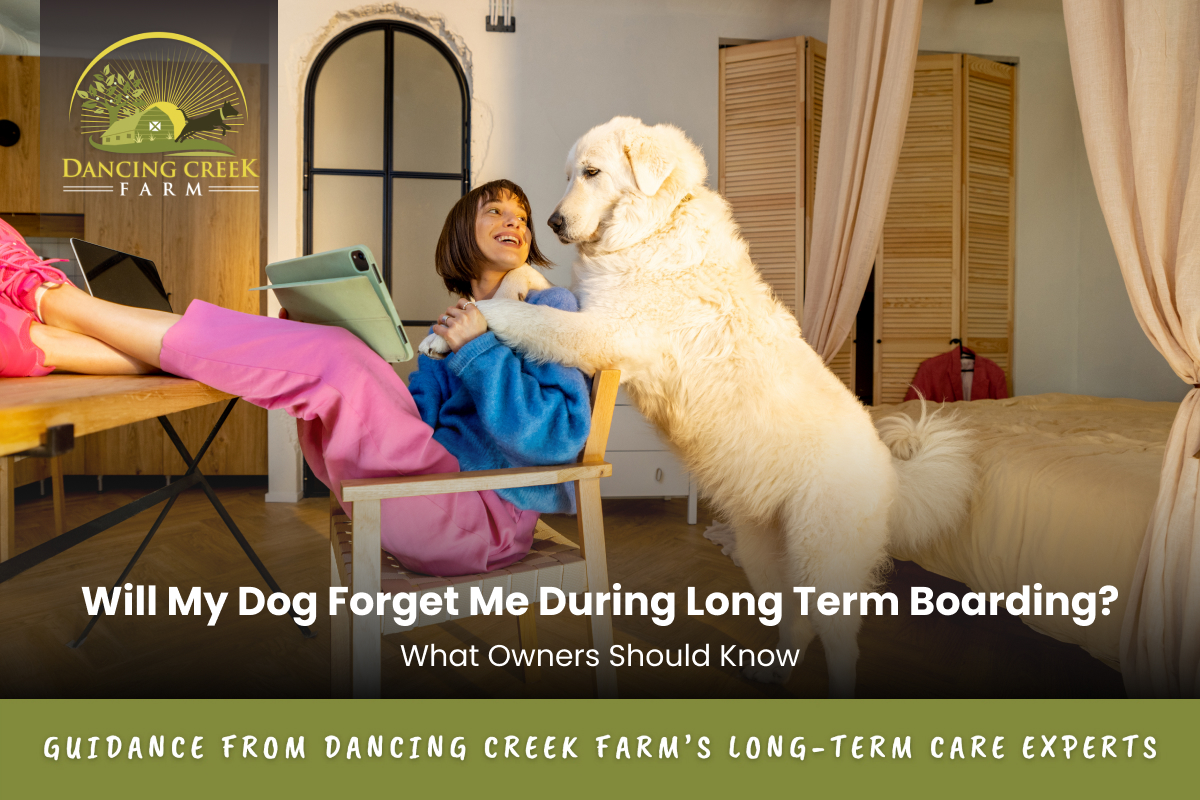
Leaving your dog for several weeks or months can bring up one of the most emotional questions an owner can ask: “Will my dog forget me?”
It is a completely understandable concern. Dogs are part of the family, and their daily lives are often built around familiar people, routines, smells, and places. When that routine changes because of travel, military deployment, relocation, work, or another extended commitment, owners may worry that a long absence could weaken the bond they have built with their dog.
The good news is that long term dog boarding does not mean your dog simply forgets you.
Dogs can form strong attachments to people, and changes in a dog’s routine can affect behavior and emotions. However, a temporary separation is very different from permanently losing a familiar person. Dogs can adapt to a new routine while still maintaining their relationship with their owners.
The key is making sure the boarding experience provides safety, consistency, appropriate care, and enough positive interaction for the dog to feel secure while away.
Do Dogs Remember Their Owners After Long-Term Boarding?
Yes, dogs can recognize and remember familiar people after periods of separation.
Your dog does not need to see you every day to maintain familiarity with you. Your scent, voice, appearance, and the experiences you have shared all contribute to your relationship.
During long term dog boarding, your dog may become comfortable with new caregivers and develop a temporary routine that does not include you. That does not mean your dog has replaced you or forgotten the relationship you share.
In fact, becoming comfortable with caregivers can be a positive sign.
A dog that learns to relax, eat, sleep, exercise, and interact appropriately while boarding is demonstrating an ability to adapt to a temporary change.
Why Your Dog May Seem Different When You Pick Them Up
One thing that can surprise owners is their dog’s behavior at reunion.
Some dogs become extremely excited. They may jump, wag their tails, vocalize, or stay very close to their owner.
Other dogs may appear surprisingly calm.
That does not automatically mean the dog is no longer attached to you.
Dogs respond to reunions differently. Your dog may also be tired after travel, processing the change in routine, or simply transitioning from one environment back into another.
The important thing is to look at the overall relationship rather than interpreting one moment at pickup.
A dog that comfortably interacted with caregivers during boarding has not necessarily become less bonded to its family. It may simply have learned that it can feel safe with more than one trusted person.
A Healthy Boarding Routine Can Help Dogs Adjust
One of the most important parts of successful dog boarding adjustment is predictability.
Imagine your dog’s normal day at home.
There may be a familiar time for breakfast, walks, play, naps, bedtime, and interaction with family. When a dog enters a boarding environment, those familiar patterns change.
A thoughtful boarding program replaces uncertainty with a new routine.
That might include:
- Consistent feeding times
- Regular exercise
- Predictable rest periods
- Familiar caregivers
- Safe outdoor activity
- Comfortable sleeping arrangements
- Individual attention
- Monitoring of appetite and behavior
At Dancing Creek Farm, dogs stay in climate-controlled cabins with their own fenced yards, while the facility also provides larger fenced areas for exercise and enrichment. The farm emphasizes individualized care rather than treating every dog exactly the same.
For a dog staying several weeks or months, this consistency can become an important source of security.
Your Dog Can Be Happy Without Forgetting You
This is perhaps the most important distinction for worried owners.
A dog being comfortable at boarding is not evidence that your dog doesn’t miss you.
It is actually something owners should want.
If your dog cannot relax, eat, sleep, exercise, or interact with caregivers unless you are present, an extended separation can be much harder.
A good boarding experience gives dogs an opportunity to learn:
“My family is away, but I am still safe.”
That is very different from:
“My family no longer matters.”
The ability to adapt does not erase attachment.
What About Dogs With Separation Difficulties?
Some dogs have a particularly difficult time when separated from their owners. Others are naturally more independent.
This is one reason boarding facilities should evaluate dogs individually.
A dog’s age, temperament, previous experiences, social behavior, training, and familiarity with boarding can all influence how they respond to a new environment.
Owners should be honest during the intake process about behaviors such as:
- Excessive distress when left alone
- Destructive behavior
- Persistent barking
- Difficulty eating when separated
- Previous negative boarding experiences
- Fear of unfamiliar people
- Reactivity toward dogs
- Medical or behavioral concerns
At Dancing Creek Farm, owners are asked detailed questions about their dog’s temperament, interactions with other dogs, previous boarding or daycare experience, and why boarding is needed. This information helps the team understand the dog before the stay begins.
That individualized approach is particularly important for longer stays.
A Real Example From Dancing Creek Farm
One example that illustrates this well comes from a family whose dogs stayed at Dancing Creek Farm for five months.
According to the owner’s review, the dogs returned home healthy and happy after their extended stay. The family received regular pictures, allowing them to see how their dogs were doing throughout the boarding period.
What is particularly interesting is that the owner described the dogs as comfortable enough at the farm that they did not appear to be in a hurry to leave.
For an owner, that can initially sound almost contradictory:
“If my dog is happy there, does that mean they don’t need me anymore?”
No.
It means the dogs had successfully developed a sense of security in another environment.
The goal of quality long-term care is not to make dogs choose between their family and their caregivers. It is to help them feel safe while their family is temporarily away.
When the owners returned, the dogs could reconnect with their family while also having had a positive experience during the separation.
That is exactly the type of outcome owners should hope for.
How Owners Can Maintain the Bond During Boarding
You do not need to constantly communicate with your dog to preserve your relationship.
In fact, what matters most is the quality of the relationship you have built over time.
Before boarding, you can help by maintaining familiar habits and giving the boarding team accurate information about your dog’s routine.
You can also provide appropriate comfort items if the facility permits them.
At Dancing Creek Farm, communication is another important part of the experience. The farm says families can receive pictures and videos and can use communication options such as FaceTime or WhatsApp to stay connected.
These updates can be valuable for dog separation from the owner, particularly for the humans involved.
Sometimes the owner needs reassurance just as much as the dog needs care.
What Happens When Your Dog Comes Home?
The reunion is only one part of the transition.
After a long stay, your dog may need some time to readjust to home life.
You may notice temporary changes such as:
- Sleeping more than usual
- Being unusually excited
- Wanting extra attention
- Being slightly unsettled by changes in routine
- Needing time to settle back into normal household patterns
Try not to expect your dog to immediately behave exactly as they did before boarding.
Instead, return to familiar routines gradually.
Feed meals at normal times, provide appropriate exercise, allow plenty of rest, and give your dog time to reconnect with the household.
The same principle that helps during dog boarding adjustment, predictability, can also help when your dog returns home.
Choosing the Right Boarding Environment Matters
Not every boarding experience is the same.
If your dog will be away for an extended period, look beyond the question of whether a facility has availability.
Ask:
- How are dogs introduced to the environment?
- Are individual temperaments considered?
- Where will my dog sleep?
- How much outdoor time is available?
- What happens if my dog is uncomfortable around other dogs?
- How often will staff interact with my dog?
- How will behavioral or health concerns be communicated?
- Will I receive updates during the stay?
At Dancing Creek Farm, dogs can have private cabins and fenced yards, including accommodations for dogs that are not comfortable in group settings. The farm also emphasizes experienced handlers, outdoor areas, enrichment, and communication with families.
For long stays, these details can make a meaningful difference.
Final Thoughts: Your Dog Doesn’t Need to Choose
The fear that your dog will forget you during Long Term Dog Boarding usually comes from a place of love.
You may imagine your dog wondering where you went, becoming attached to someone else, and eventually returning home as a completely different dog.
But a healthier way to think about boarding is this:
Your dog can learn to be comfortable without you while still loving and remembering you.
A successful boarding experience should give your dog stability during your absence, not replace the bond you share.
The goal is for your dog to have a safe, structured, positive experience while you are away and then comfortably transition back into life with you when you return.
At Dancing Creek Farm, the focus is on creating an environment where dogs can feel secure, receive individualized attention, maintain predictable routines, and enjoy their time away from home. For owners considering dog boarding in Virginia for an extended stay, choosing a facility that understands both the dog’s needs and the owner’s concerns can make the entire experience easier.
Your dog doesn’t have to forget you to enjoy their stay.
And you don’t have to feel guilty for giving them the opportunity to feel safe, confident, and cared for while you’re away.
Frequently Asked Questions
1. Will my dog forget me after long term boarding?
No. Dogs can maintain familiarity with and attachment to their owners even when separated for an extended period. A dog becoming comfortable with caregivers does not mean the relationship with its owner has disappeared.
2. How long does it take a dog to adjust to long term boarding?
Every dog is different. Some settle quickly, while others need several days or longer. Age, temperament, previous boarding experiences, and the dog’s ability to adapt to new routines can all influence the adjustment period.
3. Will my dog be sad while I am away?
Some dogs may show temporary signs of stress or changes in behavior when their routine changes. A consistent dog boarding routine, attentive caregivers, appropriate exercise, and a suitable environment can help many dogs adjust.
4. Should I stay in contact with my dog during long term boarding?
Owner updates can provide reassurance and help families feel connected. Dancing Creek Farm provides families with pictures and videos and offers communication options such as FaceTime or WhatsApp.
5. How can I make long term dog boarding easier for my dog?
Provide accurate information about your dog’s routine, temperament, food, medications, and previous experiences. Choose a boarding facility that individualizes care, maintains consistent routines, monitors behavior, and communicates with you throughout the stay.