
What you need to know:
|
Boarding or pet sitter? Choosing between dog boarding vs pet sitter care comes down to three things: how long you’ll be gone, what your dog is like, and how much unsupervised time you’re willing to accept. I run a boarding farm, and I’ll still tell you when a pet sitter is the smarter call.
| Short answer
For a weekend away with a relaxed adult dog, hire a vetted pet sitter. For trips longer than about two weeks, or for puppies, anxious dogs, escape artists, or dogs with medical needs, choose a reputable boarding facility with staff on site overnight. Everything between those points depends on your dog. |
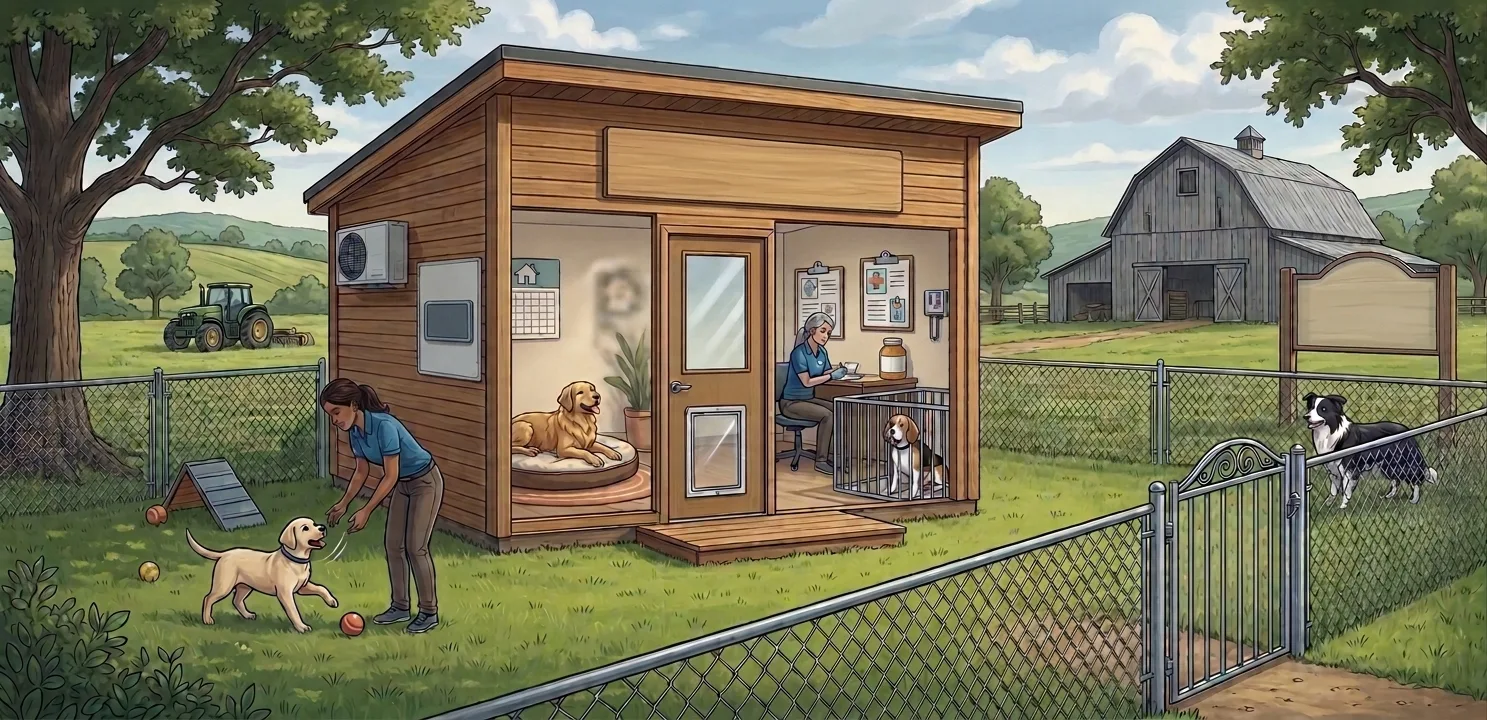
I’ve operated Dancing Creek Farm in Cascade, Virginia since 2005. Our dogs live in 35+ climate-controlled cabins with private fenced yards, and we’ve watched thousands of owners wrestle with this exact choice. Here’s the framework we walk them through.

What is the difference between dog boarding and a pet sitter?
Dog boarding means your dog stays at a facility, a kennel, or a sitter’s home while you travel. A pet sitter cares for your dog in your own home, either through short visits or by staying overnight.
Think of it like childcare. A pet sitter is the babysitter who comes to your house. Boarding is summer camp: a new place, a set schedule, and other kids to play with.
Within those two buckets, you’ll find several distinct services:
- Drop-in visits: a sitter stops by 2 or 3 times a day for 20 to 60 minutes to feed, walk, and let your dog out.
- Overnight pet care at home: the sitter sleeps at your house, so your dog has company at night.
- Live-in house sitting: a sitter moves in for the whole trip.
- In-sitter’s-home boarding: your dog stays at the sitter’s house, often alongside their own pets.
- Kennel or facility boarding: your dog sleeps in a run or suite at a commercial facility with trained staff.
- Farm or resort boarding: larger spaces, outdoor play areas, and often private sleeping quarters.
In home dog sitting is the umbrella term most people search for when they mean either drop-ins or overnight care in their own house. Dog daycare is a different service entirely: daytime supervision and play, with your dog home every night. It’s a great fit for workdays, but it doesn’t solve a vacation.
Dog boarding vs pet sitter: which is better for your trip?
The best option for your dog while on vacation depends mostly on trip length and temperament. We built the matrix below from what we see at check-in every week.
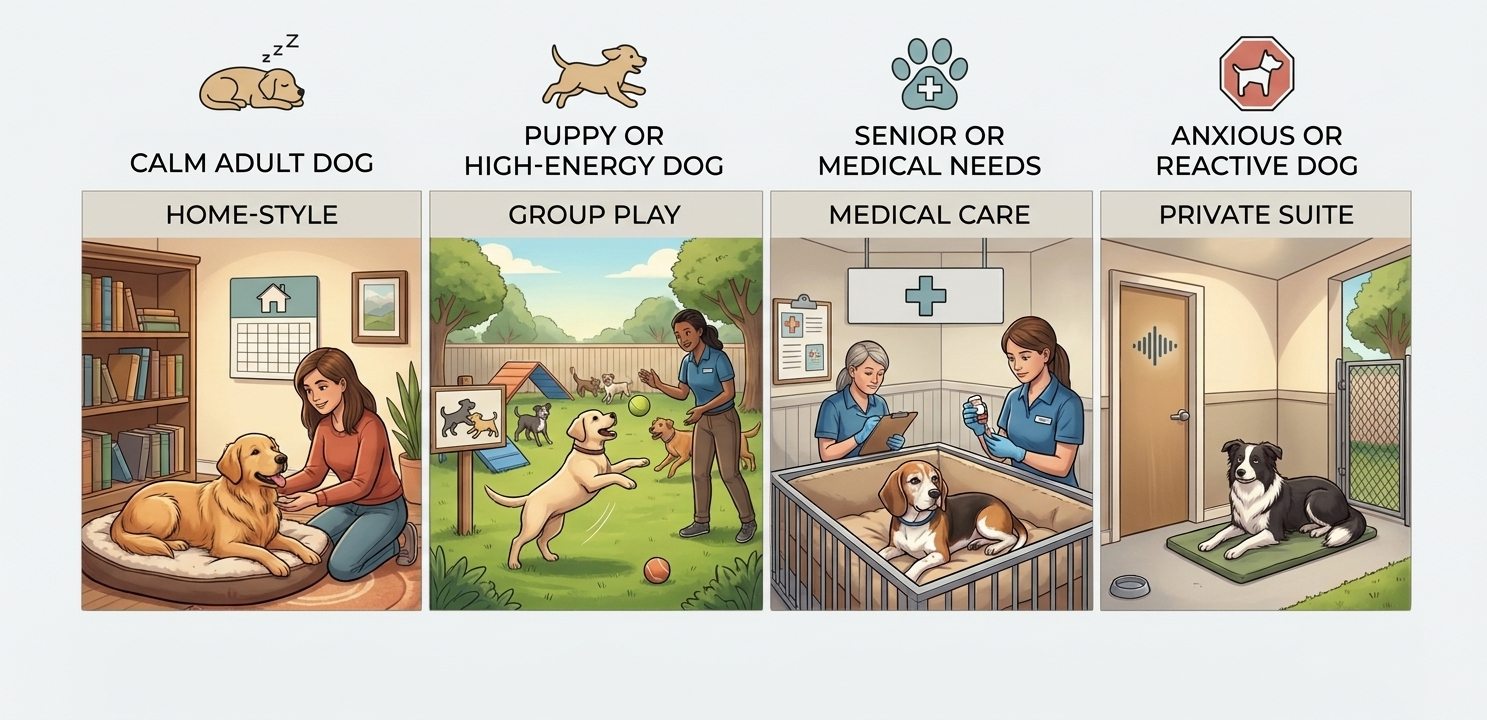
| Trip length | Calm adult dog | Puppy or high-energy dog | Senior or medical needs | Anxious or reactive dog |
| 1 to 3 nights | Pet sitter (drop-ins or overnight) | Overnight sitter or boarding | Overnight sitter | Overnight sitter in your home |
| 4 to 14 nights | Either; overnight sitter or boarding | Boarding | Overnight sitter or boarding with vet access | Boarding with private quarters, or live-in sitter |
| 2 weeks to 3 months | Boarding | Boarding | Boarding with medication support | Boarding with private quarters |
| 3+ months | Long-term boarding | Long-term boarding, ideally with training | Long-term boarding with vet coordination | Long-term boarding with private quarters |
Two patterns jump out. First, short trips favor the dog’s home turf. Second, the longer the absence, the more structure beats familiarity.
Why does length matter so much? A dog alone for 20 hours a day can cope for a weekend. Stretch that across three weeks and boredom, anxiety, and destructive habits tend to build.
I cover how stay length changes the plan in our breakdown of short-term vs long-term dog boarding.
When is a pet sitter the better choice?
A pet sitter is the better choice when your dog is calm, healthy, and deeply attached to home, and your trip is short. Here’s when I’d honestly point you toward a sitter instead of our own cabins:
- You’re gone 1 to 3 nights. Our short-term stays have a 3-night minimum for exactly this reason. A quick weekend rarely justifies the adjustment period.
- Your senior dog struggles with change. Older dogs with arthritis or cognitive decline often rest better in their own bed.
- You have several pets of different species. A sitter can handle the dog, the cats, and the fish in one visit.
- Your dog isn’t fully vaccinated. Most boarding facilities won’t accept unvaccinated dogs, so a sitter may be your only option.
- You have a sitter you already trust. A neighbor your dog adores beats a stranger every time.
The catch is supervision. Even with three drop-in visits a day, a dog can spend 20+ hours alone. That’s fine for many adult dogs over a weekend. It’s risky for puppies, dogs that chew or escape, and dogs that panic when left alone.
When is boarding the better choice?
Boarding is the better choice when your dog needs supervision, activity, and routine more than they need their own couch. Puppies, energetic dogs, and dogs that get into trouble alone usually do better in a facility with staff around.
The pet sitter vs kennel question often comes down to backup coverage. A sitter is one person. If they get sick, get stuck in a snowstorm, or simply don’t show up, your dog waits. A facility with overnight staff has a plan B built in.
Boarding also tends to win when:
- The trip is longer than two weeks. Daily structure, play, and human contact keep dogs settled over long absences.
- Your dog is social. Supervised group play burns energy that a 30-minute walk can’t.
- Your dog needs medication on a strict schedule. Staff on site means doses don’t depend on one person’s calendar.
- You have no reliable local sitter. Some facilities, including ours, offer door-to-door dog transport so distance isn’t a barrier.
Group settings carry one real tradeoff: respiratory illness. PBS NewsHour’s December 2023 coverage of a dog respiratory outbreak named boarding facilities, daycares, and dog parks as places where illness can spread.
The same report quoted the CEO of the International Boarding & Pet Services Association, who said reputable facilities inspect dogs closely and isolate sick ones. Ask any facility how it handles that.
If your dog doesn’t enjoy group play, look for private boarding cabins instead of group boarding. Your dog gets supervision without the crowd.
How much does a dog sitter cost compared with dog boarding?
Dog sitter cost and dog boarding cost land closer together than most people expect per night. The gap opens up on long trips. Here’s what published 2025 and 2026 figures show:
| Option | Typical price | Source and date |
| Professional drop-in visit (30 min) | $25 to $50 per visit | Adopt a Pet, July 2025 |
| Overnight pet sitter | $75 to $150 per night | Adopt a Pet, July 2025 |
| In-home sitting (marketplace median) | About $51 per night | Wag!, July 2026 |
| Dog boarding (marketplace median) | About $53 per night, most stays $39 to $76 | Wag!, July 2026 |
| Standard kennel boarding | $25 to $85 per night | Petful, 2026 |
| Dancing Creek Farm short-term (shared cabin) | $45 per day under 55 lbs, $55 over 55 lbs | Our current rates, October 2026 |
| Dancing Creek Farm long-term (shared cabin, 3+ months) | $675 per month | Our current rates, October 2026 |
Now run the math for a two-week trip with one dog. Three professional drop-ins a day at $25 to $50 each comes to roughly $1,050 to $2,100.
An overnight sitter at $75 to $150 a night lands in the same range. Boarding at the Wag! median of $53 a night is about $742.
Long absences change the picture completely. A three-month stay with an overnight sitter starts around $6,750. Our long-term shared cabin rate works out to about $22 a day, or $2,025 for three months. Monthly pricing is where boarding pulls far ahead.
Prices vary a lot by city, holidays, and extra dogs, so treat these as starting points. Rover’s May 2026 city data, for example, puts the national average for boarding at $30 to $50 per night, with higher-cost metros above that.
| Planning a longer trip? Our long-term dog boarding in Virginia page lists every rate, what’s included, and how transport works. |
Where should you leave your dog while on vacation?
Where to leave your dog while on vacation is easier to decide with a short checklist. Work through these five steps before you book anything:
- Count the nights. Under four, start with sitters. Over fourteen, start with boarding.
- Estimate hours alone. Multiply the gaps between sitter visits across the trip. If the number makes you wince, it probably bothers your dog too.
- Be honest about your dog. Puppies, chewers, escape artists, and dogs with separation anxiety need more supervision than visits provide.
- Check the health basics. Confirm vaccinations, medications, and who will drive your dog to a vet in an emergency.
- Do a trial run. Book one night of boarding or one sitter day before the real trip, and watch how your dog comes home.
Leaving a dog for vacation feels less stressful once you have a plan. My guide on how to prepare your dog for boarding covers the packing list and the first-night routine.

How do you vet a pet sitter or a boarding facility?
Vet either option the same way: meet them first, verify insurance, and ask about emergencies. The American Kennel Club’s November 2025 guidance on choosing a sitter recommends checking pet first aid training, insurance and bonding, references, and a written agreement.
Questions for a pet sitter:
- Are you insured and bonded, with proof to show?
- Who covers if you get sick or can’t make it?
- How many hours will the dog be alone each day?
- Are you a member of Pet Sitters International or the National Association of Professional Pet Sitters?
Questions for a boarding facility:
- Can owners tour where dogs sleep and play?
- Is someone on site overnight?
- Do you require Bordetella and other core vaccines, and how do you handle sick dogs?
- Are you a member of the International Boarding & Pet Services Association?
A good operator welcomes these questions. We’d be wary of anyone who won’t show you the space.
If you’re hiring a sitter, the American Kennel Club also suggests a trial day before the real trip and finding candidates through groups like Pet Sitters International. My checklist on what to look for in long-term dog boarding goes deeper on facilities.
What are the options for dog care while traveling for months?
Dog care while traveling for months, deploying, or relocating rules out most sitters. Few can commit to 90+ consecutive nights, and the cost climbs fast.
This is where long-term boarding earns its place. Dogs settle into a routine, usually within the first few days, and keep it for the whole stay.
Many owners worry their dog will forget them. In my experience, they don’t, and I explain why in our post on whether dogs forget their owners during long-term boarding.
Military families face this choice more than most. If that’s you, our page on dog boarding for military deployment covers discounts and the paperwork to prepare.
One example is a dog staying at Dancing Creek Farm while their family manages an extended work assignment away from home. At first, a change in surroundings and daily routine can take some getting used to. With consistent care, regular meals, outdoor time, and familiar routines, dogs have opportunities to settle in at their own pace. For families facing a long deployment or relocation, having a dependable place for their dog can make an already stressful transition feel more manageable.
Frequently asked questions
Is boarding stressful for dogs?
Boarding can be stressful for the first day or two, especially for dogs that have never stayed away from home. Most dogs adjust quickly when the facility keeps a steady routine, offers outdoor time, and limits crowding. A one-night trial stay before a long trip shows you how your dog handles it.
What is the best option for a senior dog while on vacation?
For short trips, an overnight sitter in your home is usually easiest on a senior dog’s joints and routine. For longer trips, choose a facility with quiet private space, staff who can give medications on schedule, and a working relationship with a local veterinarian. Avoid busy group play areas for frail dogs.
Can you leave a dog home alone with a neighbor checking in?
For one night with a calm adult dog, a reliable neighbor checking in two or three times can work. Beyond that, the hours alone add up quickly. Make sure your neighbor has your vet’s number, a key backup plan, and written feeding and medication instructions before you leave.
What vaccines do dogs need for boarding?
Most boarding facilities require rabies, distemper and parvovirus (often given as a combination vaccine), and Bordetella, the main kennel cough vaccine. Requirements vary, so ask before you book and allow time for boosters. Some facilities, including ours, can coordinate overdue vaccines through a local vet.
The bottom line
The dog boarding vs pet sitter decision isn’t about which service is better. It’s about which one leaves your dog alone the least for the length of your trip.
|
Before you travel, put a plan B in place either way. Our post on why every dog owner needs a backup care plan walks through it.
When you’re ready, you can check availability at Dancing Creek Farm.